Wills and trusts NYC attorney representation
Last updated: 2026-05-04
When you need a wills and trusts NYC attorney, you require legal counsel capable of executing precise estate planning strategies under New York law. I am Russel Morgan, Esq. My firm, Morgan Legal Group P.C., manages over 1,000 active estate cases. We draft Last Wills and Testaments. We also structure Revocable Living Trusts and complex Irrevocable Trusts for residents across all five boroughs. An effective estate plan dictates exactly how your assets transfer upon your death. It minimizes your exposure to estate taxes and shields your beneficiaries from creditors.
New York estate planning requires strict adherence to the Estates, Powers and Trusts Law (EPTL) and the Surrogate’s Court Procedure Act (SCPA). A simple drafting error invalidates your entire plan. The estate tax landscape is shifting rapidly. The federal estate tax exemption of $13.99 million in 2025 sunsets on January 1, 2026, dropping to approximately $7 million. Simultaneously, New York imposes a $7.16 million state exemption with a punitive 105% cliff penalty. If your estate exceeds the New York limit by even five percent, you lose the entire exemption. We structure your assets to avoid these tax traps. We keep your family out of protracted court proceedings and ensure your exact wishes are legally binding.
The wills and trusts process across all five boroughs
Creating a legally sound estate plan in New York City involves specific statutory requirements. A Last Will and Testament provides the foundation of most estate plans, but trusts offer superior control and privacy. The specific tools we deploy depend entirely on your asset profile, your family dynamics, and your long-term financial goals.
Drafting and executing a New York will
Under EPTL § 3-2.1, the execution of a Last Will and Testament in New York requires strict formalities. The testator must be at least 18 years old and of sound mind. They must sign the document at the end in the presence of at least two adult witnesses. These witnesses must sign their names and affix their residential addresses within 30 days of each other. We conduct formal execution ceremonies at Morgan Legal Group P.C. to ensure absolute compliance. We leave nothing to chance. During this ceremony, we also execute a self-proving affidavit. This affidavit prevents the Surrogate’s Court from hunting down witnesses decades later to verify signatures.
Many clients utilize a pour-over will. It acts as a safety net for a trust-based estate plan. If you forget to transfer a $50,000 Citibank savings account or a newly purchased piece of real estate into your trust during your lifetime, the pour-over will captures that asset at your death. It then transfers the property directly into your trust. This ensures your trust remains the master document governing asset distribution.
We also frequently draft testamentary trusts within wills. Unlike a living trust, a testamentary trust only springs into existence after you die and the Surrogate’s Court admits your will to probate. These structures effectively protect assets left to minor children. A designated trustee manages the funds until the child reaches age 25 or 30.
Establishing revocable and irrevocable trusts
Trusts fall under EPTL Article 7. A Revocable Living Trust (RLT) allows you to maintain total control over your assets during your lifetime. You retain the power to amend the trust. You control the beneficiary designations. You hold the right to revoke the trust entirely. The primary advantage of an RLT is probate avoidance. Assets properly funded into an RLT transfer immediately to your beneficiaries upon your death, completely bypassing the Surrogate’s Court. This saves your family months of delay and thousands of dollars in legal fees.
Irrevocable trusts serve a different purpose. Once you establish and fund an irrevocable trust, you surrender the right to alter it. In exchange for relinquishing control, you gain significant tax advantages and asset protection. We routinely draft the following irrevocable structures:
- Irrevocable Life Insurance Trusts (ILIT): Life insurance payouts are generally income tax-free, but the IRS includes them in your taxable estate. An ILIT owns your life insurance policy, removing the death benefit from your taxable estate and protecting your family from the New York estate tax cliff.
- Medicaid Asset Protection Trusts (MAPT): Nursing home care in New York City easily exceeds $15,000 per month. A MAPT protects your home and life savings from Medicaid estate recovery. You must fund this trust at least 60 months before applying for Medicaid to satisfy the federal look-back period.
- Grantor Retained Annuity Trusts (GRAT): A GRAT allows you to transfer high-appreciating assets to your heirs while minimizing gift taxes. You receive an annuity payment for a term of years. If the trust assets appreciate faster than the IRS hurdle rate, the excess passes to your beneficiaries tax-free.
- Intentionally Defective Grantor Trusts (IDGT): The IRS treats an IDGT as a grantor trust for income tax purposes but as a separate entity for estate tax purposes. You pay the income taxes on the trust’s earnings, allowing the trust assets to grow tax-free for your beneficiaries.
- Charitable Remainder Trusts (CRT) and Charitable Lead Trusts (CLT): These trusts generate income for you or your beneficiaries while providing a remainder interest to a charity, or vice versa. They offer substantial immediate income tax deductions.
- Special Needs Trusts: If you have a beneficiary receiving government benefits like SSI or Medicaid, an outright inheritance disqualifies them. A Special Needs Trust provides supplemental funds for their care without jeopardizing their eligibility for state and federal assistance.
Trust administration and modification
Trust administration involves managing and distributing trust assets according to the grantor’s instructions. Trustees in New York are bound by the strict fiduciary duties outlined in EPTL Article 11. These include the duty of loyalty and the duty of impartiality. Trustees must also comply with the Prudent Investor Act. Beneficiaries will hold a trustee personally liable for losses if that trustee mismanages funds or engages in self-dealing.
Sometimes, an older irrevocable trust no longer serves its intended purpose due to changing tax laws or family circumstances. New York allows for trust modification and decanting under EPTL § 10-6.6. Decanting allows a trustee with absolute discretion to pour the assets of an old, outdated trust into a brand new trust with more favorable administrative terms, provided the beneficiary class remains the same.
Local Surrogate’s Court details in New York City
If you rely on a will rather than a fully funded living trust, your estate must go through the probate process. In New York City, probate occurs in the Surrogate’s Court of the county where the deceased resided. In my 25 years of practice, the most common surprise for new executors is the severe administrative delay at the courthouse. According to the New York State Unified Court System’s annual reports, the Surrogate’s Courts handle over 130,000 probate, administration, and guardianship filings statewide each year. This creates massive administrative backlogs in the five boroughs. The court system operates uniformly under the SCPA, but each borough has its own courthouse and specific procedural nuances.
Court locations across the five boroughs
We actively practice in all five local Surrogate’s Courts. You must file your probate petition, the original Last Will and Testament, and the certified death certificate at the correct location:
- Manhattan (New York County): 31 Chambers Street, New York, NY 10007.
- Brooklyn (Kings County): 2 Johnson Street, Brooklyn, NY 11201.
- Queens (Queens County): 88-11 Sutphin Blvd, Jamaica, NY 11435.
- Bronx (Bronx County): 851 Grand Concourse, Bronx, NY 10451.
- Staten Island (Richmond County): 18 Richmond Terrace, Staten Island, NY 10301 [VERIFY current room number].
Phone numbers and operating hours vary by borough [VERIFY], but all courts generally accept filings between 9:00 AM and 5:00 PM, Monday through Friday. We handle all court communications and appearances on behalf of the named executor.
Filing fees under SCPA § 2402
The Surrogate’s Court charges a mandatory filing fee to process a probate or administration petition. Under SCPA § 2402, the current 2025 fee schedule is strictly based on the gross value of the estate passing through the court:
- Estate value less than $10,000: $45
- $10,000 to $19,999: $75
- $20,000 to $49,999: $215
- $50,000 to $99,999: $280
- $100,000 to $249,999: $420
- $250,000 to $499,999: $625
- Estate value of $500,000 or more: $1,250
These fees only apply to probate assets. Assets held in a Revocable Living Trust or assets with direct beneficiary designations (like life insurance or 401k accounts) do not incur Surrogate’s Court filing fees because they bypass the court entirely.
Processing times and judicial review
Processing times fluctuate wildly depending on the borough. Manhattan frequently experiences processing times of 8 to 15 months due to sheer case volume and the complexity of high-net-worth estates. Brooklyn and Queens often take 7 to 12 months. Staten Island and the Bronx process simpler estates in 6 to 10 months. The sitting Surrogate in each county reviews contested matters. These include kinship hearings under SCPA § 1411 and will contests based on undue influence or lack of testamentary capacity.
Common estate planning case types in NYC
New York City presents unique estate planning challenges. The density of co-op apartments requires specific transfer strategies. The high concentration of financial wealth demands aggressive tax planning. Furthermore, the diverse international population necessitates cross-border coordination. We tailor our approach to the specific realities of your borough and neighborhood.
Manhattan: High-net-worth tax planning
In Manhattan neighborhoods like the Financial District, Tribeca, and SoHo, we frequently represent ultra-high-net-worth individuals. Clients in Midtown and the Upper East Side require aggressive tax minimization strategies. We utilize GRATs and IDGTs to transfer carried interest, private equity assets, and highly appreciated real estate out of the taxable estate. For clients in Harlem and Washington Heights, we shift focus. We protect brownstones and multi-family properties from long-term care costs using Medicaid Asset Protection Trusts.
Brooklyn: Young professionals and real estate wealth
Brooklyn property values have exploded. In Brooklyn Heights and Park Slope, we draft Revocable Living Trusts for young professionals. These clients want to ensure testamentary trusts and designated guardians protect their minor children. In Bedford-Stuyvesant and Crown Heights, we focus heavily on generational wealth transfer. We ensure family homes are not lost to Brooklyn probate disputes or Medicaid liens. For older clients in Bay Ridge and Brighton Beach, elder law planning and irrevocable trusts take priority.
Queens: Multi-generational homes and asset protection
Queens is defined by diverse neighborhoods and multi-generational living arrangements. In Forest Hills and Astoria, families often own two-family or three-family homes. We use trusts to ensure these properties pass smoothly to the next generation. This avoids triggering a reassessment or forcing a sale to cover estate taxes. In Flushing and Long Island City, we assist small business owners with succession planning and pour-over wills.
Hypothetical Scenario: Consider a Forest Hills resident facing a terminal diagnosis. They own a multi-family home worth $2.5 million and have $500,000 in liquid assets. If they rely on a simple will, their estate stalls in Queens probate for a year. Their children must pay the $1,250 filing fee while funding property maintenance out of pocket. By transferring the property and bank accounts into a Revocable Living Trust, the assets pass immediately to the children upon death. This bypasses the court entirely. The children collect rental income without interruption.
The Bronx: Co-op transfers and probate avoidance
In the Bronx, neighborhoods like Riverdale and Co-op City feature a heavy concentration of cooperative apartments. Transferring a co-op after death is notoriously difficult if the apartment is stuck in Bronx probate. Co-op boards are strict. They routinely delay executor approvals. We advise Bronx clients to transfer their co-op shares into a living trust during their lifetime. This requires a specific trust transfer agreement approved by the co-op board. Once completed, it guarantees a seamless transition of the apartment to the beneficiaries.
Staten Island: Business succession and family estates
Staten Island clients in Tottenville and Todt Hill often own large single-family homes and local businesses. We utilize operating agreements, buy-sell agreements, and living trusts. These structures ensure a sudden death does not paralyze a family-owned construction company or retail business. We also draft pet trusts under EPTL § 7-8.1 for Staten Island clients. This legally sets aside funds and designates a caregiver to ensure family dogs or cats receive proper care after the owner’s passing.
When you need a wills and trusts attorney
Estate planning is not a one-time event. You need a qualified attorney when you experience major life changes. Marriage, divorce, the birth of a child, or the purchase of real estate all demand immediate document updates. However, the most urgent reason to hire a wills and trusts attorney today is the shifting tax code.
The 2026 federal estate tax sunset
The Tax Cuts and Jobs Act (TCJA) of 2017 temporarily doubled the federal estate tax exemption. In 2025, an individual transfers $13.99 million (or $27.98 million for a married couple) free of federal estate tax. On January 1, 2026, these provisions sunset. The exemption reverts to 2017 levels, adjusted for inflation, landing at approximately $7 million per individual. If your global assets exceed $7 million, your family faces a 40% federal tax on the overage. You must act before the end of 2025. We utilize the current high exemption amounts through strategic gifting and irrevocable trusts.
The New York estate tax cliff
New York imposes its own estate tax, completely separate from the federal system. For 2025 and 2026, the New York state exemption is $7.16 million. New York employs a devastating 105% cliff penalty. If your taxable estate exceeds the $7.16 million exemption by more than 5% (meaning your estate is worth more than $7,518,000), you lose the exemption entirely. New York taxes your estate from dollar zero. A few thousand dollars in excess assets triggers a tax bill of hundreds of thousands of dollars. We utilize spousal lifetime access trusts (SLATs) and charitable giving strategies to keep your estate below the cliff threshold.
Spousal rights of election
Under EPTL § 5-1.1A, you cannot entirely disinherit a legal spouse in New York. A surviving spouse holds a legal right of election to claim the greater of $50,000 or one-third of the deceased spouse’s augmented estate. The augmented estate includes probate assets, trust assets, and joint bank accounts. Suppose you are separated but not legally divorced. Or suppose you are in a second marriage and wish to leave all your assets to children from a first marriage. You need an attorney to draft a valid prenuptial or postnuptial agreement. In this document, the spouse explicitly waives their right of election under EPTL § 5-1.1A.
Costs, timelines, and fiduciary duties
The cost of a will in NY or a broader estate plan depends on the complexity of the documents required. A simple will costs less upfront than a fully funded trust-based plan. However, a trust saves your family substantial money and time on the back end by avoiding probate. We provide transparent fee structures during our initial consultations.
Trustee and executor duties
Whether you name an executor in your will or a trustee in your trust, you are appointing a fiduciary. EPTL Article 11 defines the powers and limitations of fiduciaries. An executor must access the deceased’s bank account records to locate assets. They must pay the deceased’s final debts, file the estate tax returns, and distribute the remaining assets to the beneficiaries. A trustee has similar duties but operates outside of court supervision. Fiduciaries must invest assets prudently. If an executor leaves $1,000,000 in a non-interest-bearing checking account for three years during probate, the beneficiaries will sue the executor for lost interest. We represent executors and trustees. We guide them step-by-step to ensure they comply with all statutory requirements and avoid personal liability.
How NYC differs from neighboring New York counties
Practicing estate law in the five boroughs requires a different operational approach than practicing in Nassau, Suffolk, or handling Westchester probate matters. The sheer volume of cases filed in New York, Kings, and Queens counties leads to significant administrative backlogs. A probate petition that takes three months to clear in a suburban county easily takes a year in Manhattan.
Furthermore, the asset profile of a New York City resident is highly specific. NYC residents heavily favor cooperative apartments. Unlike condominiums or single-family homes, a co-op is not real property. It consists of shares in a corporation paired with a proprietary lease. Transferring co-op shares into a trust or to an heir during probate requires satisfying complex, often hostile co-op board requirements. We have extensive experience negotiating with NYC co-op boards and their managing agents to execute these transfers.
Finally, NYC is a global hub. We frequently handle estates where the deceased resided in Brooklyn or Queens but owned property in Italy, Greece, or the Dominican Republic. This requires strict cross-border coordination. We ensure a New York will does not inadvertently revoke a foreign will governing overseas property.
Common pitfalls in New York estate planning and how to avoid them
Estate planning errors carry severe consequences. Because the testator is deceased when the Surrogate’s Court finally tests the documents, families have no mechanism to correct mistakes. In our firm’s review of hundreds of contested estates, we routinely see families suffer financial losses due to the following avoidable errors.
Unfunded trusts
Creating a Revocable Living Trust is only the first step. The second, and most vital, step is funding the trust. Funding means legally changing the title of your assets from your individual name to the name of the trust. If you sign a trust document but never execute a new deed transferring your Staten Island house into the trust, the house remains in your individual name. Upon your death, the Surrogate’s Court must probate the house. We oversee the funding process. We draft the necessary deeds and provide specific instructions for your financial institutions.
Hypothetical Scenario: Consider a Tribeca resident who pays an online service to generate a Revocable Living Trust. They sign the document but fail to re-title their $3 million condo or their $1 million brokerage account into the trust’s name. When they die, the trust is an empty shell. The family must hire an attorney. They must pay the $1,250 filing fee. They then wait 14 months for the Manhattan Surrogate’s Court to issue Letters Testamentary before they can sell the condo.
Improper execution ceremonies
Do-it-yourself wills frequently fail the strict requirements of EPTL § 3-2.1. If a witness is also a beneficiary in the will, their signature voids their inheritance under EPTL § 3-3.2. If someone removes the staples from the original will to make photocopies, the Surrogate’s Court suspects foul play. The court assumes pages were swapped or removed, triggering a lengthy affidavit process to explain the staple removal. We maintain strict control over original documents to prevent these administrative disasters.
Failing to update beneficiary designations
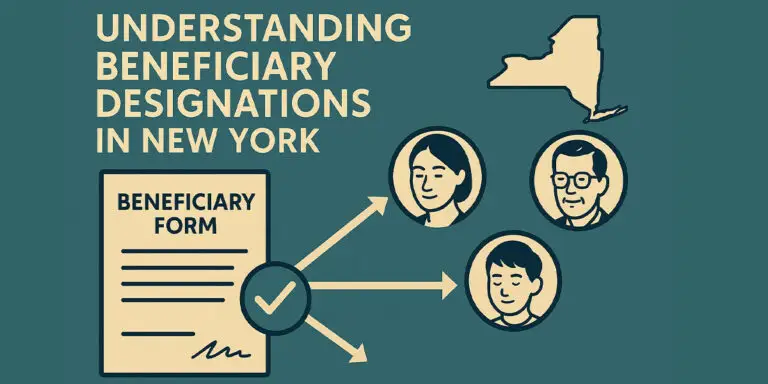
Your will does not control assets with direct beneficiary designations. Life insurance policies, 401(k)s, IRAs, and Transfer on Death (TOD) bank accounts pass directly to the named beneficiary, regardless of what your will says. If you draft a will leaving everything to your current spouse, but you forget to remove your ex-spouse as the beneficiary of your $500,000 life insurance policy, your ex-spouse will receive the money. We conduct a line-by-line review of all your beneficiary designations to ensure they align perfectly with your overall estate plan.
Frequently asked questions about wills and trusts in NYC
What is the difference between a will and a trust in New York?
A will directs the distribution of your assets after death and must go through the public probate process in Surrogate’s Court. A trust is a legal entity that holds your assets. A living trust bypasses probate entirely. It offers faster distribution and total privacy.
How much does it cost to file for probate in New York City?
Filing fees are set by SCPA § 2402 and depend on the estate’s value. Estates under $10,000 cost $45 to file. Estates over $500,000 require a maximum filing fee of $1,250. This does not include legal fees or executor commissions.
Can I write my own will in New York?
While legal, writing your own will carries massive risk. New York law (EPTL § 3-2.1) requires specific execution formalities. A minor error in witnessing or signing renders the entire document invalid. The court then distributes your estate according to state intestacy laws.
What is the New York estate tax cliff?
The NY estate tax cliff is a statutory penalty. Estates exceeding the $7.16 million exemption by more than 5% lose the entire exemption. New York then taxes the estate on its total value from dollar zero, resulting in massive tax liabilities.
How long does probate take in Manhattan?
Due to high case volume, uncontested probate in New York County (Manhattan) typically takes 8 to 15 months. Contested estates or estates with missing heirs take several years to resolve.
Do I need a trust if I only own a co-op in the Bronx?
Yes. Placing your co-op in a Revocable Living Trust is highly recommended. It prevents the co-op from getting stuck in probate. This saves your beneficiaries from paying monthly maintenance fees out of pocket while waiting for court approval to sell the unit.
What happens to the federal estate tax in 2026?
The current federal exemption of $13.99 million will sunset on January 1, 2026. It will drop to approximately $7 million per individual. High-net-worth individuals must act before 2026 to lock in the higher exemption limits.
Can I disinherit my spouse in New York?
No. Under EPTL § 5-1.1A, a surviving spouse has a right of election to claim about one-third of your augmented estate. The only way to bypass this is if the spouse signs a valid waiver, such as a prenuptial or postnuptial agreement.
What is a pour-over will?
A pour-over will operates alongside a living trust. If you die with assets still in your individual name, the pour-over will legally transfers those assets into your trust. The trustee then distributes them according to the trust’s rules.
What does a trustee do?
A trustee manages the assets held within a trust. Under EPTL Article 11, they have a fiduciary duty to invest the assets prudently, file necessary tax returns, and distribute the funds to the beneficiaries exactly as the trust document dictates.
At Morgan Legal Group P.C., we protect your assets. We minimize your tax liabilities and secure your family’s financial future. The legal standards in New York are unforgiving, and the upcoming tax sunsets require immediate action. Contact our office today to schedule a consultation with a wills and trusts NYC attorney. We will ensure your estate plan is structurally sound. Book your appointment now.