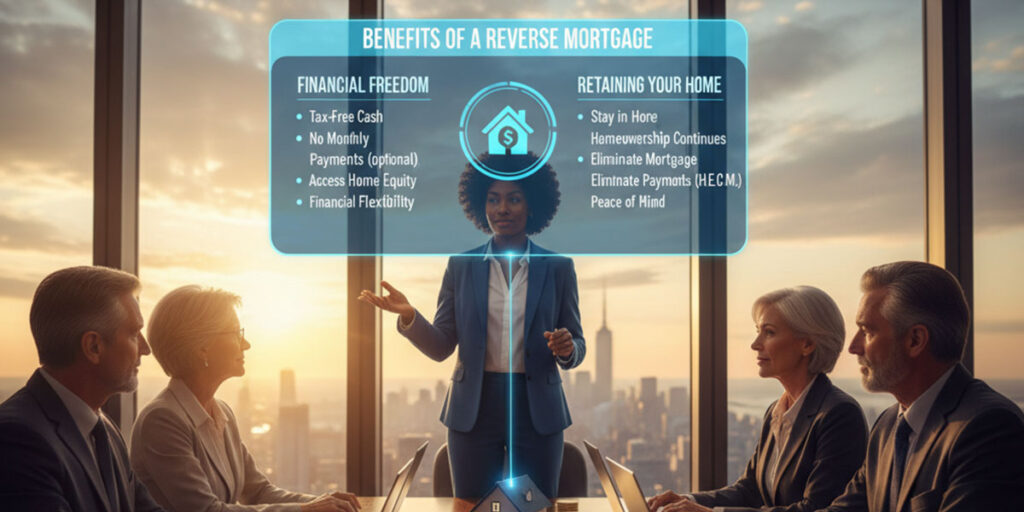
As seniors enjoy their retirement years in New York City and across New York State, managing cash flow can become a significant challenge. The cost of living continues to rise, property taxes remain high, and the potential need for long-term healthcare looms over every family budget. For many elderly homeowners, their greatest financial resource is not sitting in a bank account; it is locked inside the equity of their primary residence. This economic reality drives many to ask: **What are the benefits of a reverse mortgage?**
In New York State, a reverse mortgage—specifically a Home Equity Conversion Mortgage (HECM)—can serve as a powerful financial lifeline when utilized correctly. It allows homeowners aged 62 or older to convert a portion of their home equity into tax-free cash without being forced to sell the property or make monthly mortgage payments. However, because New York real estate values in Manhattan, Brooklyn, and Queens are exceptionally high, a reverse mortgage carries severe implications for your estate planning strategy and the legacy you leave behind.
I am Russel Morgan, the founder and lead practitioner at Morgan Legal Group. For over 30 years, our firm has served as the legal vanguard for New York families navigating the intersection of wealth preservation, elder law, and real estate. Having successfully managed over 1,000 complex cases and earned 900+ positive online reviews, we evaluate financial instruments like reverse mortgages with a cold, analytical, and highly specialized eye. In this 2026 comprehensive guide, we will break down the true benefits of this program, the strict rules enforced in New York, and how to integrate it safely into a well-developed asset protection plan.
The Mechanics of a Reverse Mortgage in New York
Before exploring the direct advantages, you must understand how a reverse mortgage alters your relationship with your property under New York law. Unlike a traditional forward mortgage where you make monthly payments to a lender to build equity, a reverse mortgage does the exact opposite.
How the Process Unfolds
The loan provider pays you out of your accrued home equity. The loan balance grows over time, and interest compounds on the outstanding balance. Crucially, you do not have to make any monthly principal or interest payments for as long as you live in the home as your primary residence. The loan only becomes due and payable when the last surviving borrower passes away, sells the home, or moves out permanently for more than 12 consecutive months.
Maintaining Home Ownership
A common misconception we address at Morgan Legal Group is that the bank takes the deed to your property. This is a dangerous myth. You retain absolute title and ownership of your home. However, you remain contractually obligated to pay your property taxes, secure homeowner’s insurance, and keep the property in good repair. Failing to meet these basic criteria can result in a default, exposing vulnerable seniors to foreclosure.
Key Benefits of a Reverse Mortgage for NY Seniors
When properly architected within a broader financial layout, the **benefits of reverse mortgage NY** protocols can drastically improve a senior’s quality of life. Below are the primary advantages recognized under current 2026 parameters.
1. Elimination of Existing Monthly Mortgage Payments
Many seniors enter retirement still carrying a traditional mortgage or a home equity line of credit (HELOC). These mandatory monthly obligations can severely drain a fixed income from Social Security or pensions. A primary benefit of a reverse mortgage is that the proceeds must first be used to pay off any existing debt on the home, immediately eliminating that monthly cash drain and freeing up significant income.
2. Supplementing Retirement Cash Flow
The remaining equity can be distributed to the homeowner in several flexible formats based on their unique lifestyle needs. You can receive the funds as:
- A single lump-sum payout (subject to specific first-year draw limits).
- A monthly tenure payment that acts as a reliable lifetime annuity.
- A flexible line of credit that grows over time if left unused, serving as an emergency reserve.
3. Tax-Free Payouts
According to the Internal Revenue Service (IRS) and New York State tax departments, reverse mortgage proceeds are considered loan advances, not earned income. Consequently, every dollar you receive is entirely tax-free. This distribution does not impact your tax brackets, nor does it typically alter your Social Security or Medicare benefits, making it an incredibly efficient wealth extraction tool.
The Critical Intersection: Reverse Mortgages and Elder Law
From an expert perspective, the most compelling application of a reverse mortgage involves funding long-term care and managing age-related health crises without draining the family’s liquid cash reserves.
Funding In-Home Care and Home Modifications
The vast majority of seniors express a desire to “age in place” rather than entering an institutional nursing home facility. However, converting a classic multi-story New York home into an accessible environment requires capital. Walk-in showers, stair lifts, and hiring 24/7 home health aides are expensive endeavors. A reverse mortgage line of credit provides the tax-free liquidity needed to fund these changes, allowing seniors to maintain their dignity and independence at home.
Medicaid Eligibility and the Payout Trap
This is where amateur financial planning can destroy a family’s safety net. Medicaid is a means-tested program with strict asset limits (approximately $31,175 for individuals in 2026). While the reverse mortgage proceeds themselves are not considered “income,” any funds that sit in your checking account into the following calendar month turn into a countable “resource.”
If you draw a $100,000 lump sum from your reverse mortgage and let it sit in a regular bank account, New York Medicaid will instantly terminate your benefits. To navigate this minefield, our firm integrates reverse mortgage draws with specialized **irrevocable trust structures** and Pooled Income Trusts to ensure you don’t lose your healthcare eligibility.
The Nightmare for Heirs: What Happens After Passing?
While the benefits to the living homeowner are clear, a reverse mortgage completely rewrites the script for your beneficiaries. When the last surviving borrower passes away, the loan balance becomes due immediately. Your heirs face a strict, high-pressure timeline managed by the lender.
The 6-Month Deadline
Lenders typically grant heirs six months to resolve the debt, either by selling the property to pay off the loan, or by refinancing the balance into a traditional forward mortgage if they wish to keep the home. While the court system allows for certain extensions if your family can show active progress, the stress is immense. If your family home is a highly valued brownstone or condo, this pressure can spark immediate **family law** disputes and inheritance battles.
The Non-Recourse Protection Shield
One vital legal benefit built into FHA-insured HECMs is that they are **non-recourse loans**. This means that if the housing market drops or the interest compounds to a point where the loan balance exceeds the actual market value of the home, your heirs are completely shielded. The lender cannot go after your children’s personal savings, brokerage accounts, or other assets to settle the difference. The bank can only claim the home itself.
Integrating a Reverse Mortgage into a Living Trust
Can you combine the benefits of a reverse mortgage with the supreme asset protection of a **Revocable Living Trust**? The answer is yes, but the execution must be flawless.
Avoiding the Probate Gridlock
As we have explored across our decades of practice, leaving a home to pass through a standard Will guarantees an expensive and slow journey through the **New York Surrogate’s Court**. Currently, probate delays in Manhattan and Brooklyn can leave real estate frozen for over a year. If you have a reverse mortgage, you cannot afford to wait 12 months for a judge to issue Letters Testamentary—the lender will foreclose long before then.
To prevent this catastrophe, we work with specific lenders who permit you to transfer your property into a Revocable Living Trust. This allows your chosen Successor Trustee to take immediate legal control of the property the week you pass away, bypassing probate completely and giving them the power to sell or refinance the home instantly, shutting down the lender’s foreclosure clock.
The New York Regulatory Environment: Unique 2026 Safeguards
New York State enforces some of the most aggressive consumer protection laws in the nation regarding reverse mortgages, specifically designed to eliminate predatory practices and protect seniors from financial exploitation and elder abuse.
Mandatory Independent Counseling
Before any lender in New York can issue a reverse mortgage, the applicant must complete a thorough counseling session with an independent housing counselor approved by the Department of Housing and Urban Development (HUD). This session ensures that the senior fully understands the long-term impact on their estate and alternative options.
The Restricted Payout Rules
To ensure seniors don’t blow through their entire home equity instantly, New York banks strictly enforce “First-Year Payout Limits.” Homeowners can generally only access up to 60% of the available loan proceeds during the initial 12 months, protecting them from aggressive scams or unvetted third-party financial products.
Hypothetical Scenario: Preserving a Legacy in Queens
To demonstrate how these strategies function in the real world, consider the story of Margaret, a retired healthcare worker living in Flushing, Queens. Margaret owned a multi-family home worth $1.5 million. Her original mortgage was completely paid off, but her monthly pension was falling short of her soaring property taxes and prescription costs.
The Wrong Approach: Margaret initially considered taking a massive lump-sum reverse mortgage on her own, leaving the funds in her personal checking account. Had she done so, she would have instantly lost her New York Community Medicaid eligibility, and upon her passing, her home would have been trapped in the Queens Surrogate’s Court backlog, leading to a forced foreclosure by the lender.
The Morgan Solution: Margaret consulted with Morgan Legal Group. We first assisted her in transferring her home into a customized Revocable Living Trust approved by her bank. We then structured her reverse mortgage as a restricted monthly tenure payout. This generated tax-free cash to cover her taxes and medical care comfortably while her Medicaid remained untouched. When she passed away two years later, her Successor Trustee took immediate title to the Queens property, selling it privately within 90 days to pay off the bank and distributing the remaining $1.2 million in equity to her children privately, securely, and completely out of court.
Why You Need Premier Counsel Before Signing
Lenders and brokers are sales professionals; their goal is to close the loan. They do not review your tax strategies or your asset vulnerability. Before signing any binding financial documentation that alters the deed to your home, you must consult an expert **estate planning attorney**.
At Morgan Legal Group, we analyze how a reverse mortgage will interact with your unique family dynamics, potential need for future **guardianship** structures, and the New York Estate Tax Cliff. We make sure that a short-term cash solution doesn’t create a long-term inheritance nightmare for your children.
Why Morgan Legal Group is the Elite Choice for NYC Families
Real estate and elder care in New York require institutional, battle-tested expertise. We do not deal in generalized internet forms or standard templates.
- 30+ Years of Authority: Our extensive history across 1,000+ successful cases gives us the perspective required to spot hidden traps in complex loan contracts.
- Unmatched Client Satisfaction: Our 900+ positive online reviews serve as indisputable proof of our precision, empathy, and absolute dedication to client outcomes.
- Comprehensive Defense: We integrate financial planning, real estate law, trust building, and litigation support into one unbreakable shield for your family.
Conclusion: Master Your Home Wealth Safely
The benefits of a reverse mortgage are significant, offering tax-free liquidity, elimination of monthly payments, and the financial freedom to age comfortably in your own home. But in New York, this freedom must be matched by elite legal architecture to ensure your children aren’t left with a foreclosure notice instead of an inheritance.
Take absolute command of your financial future today. Schedule a consultation with Morgan Legal Group. Let our team audit your property, review your family goals, and craft an estate plan that maximizes your equity while building a legal fortress around your legacy. For immediate assistance with an estate matter or a property dispute, please contact us directly. We are ready to defend you.
For more official consumer information regarding reverse mortgage requirements and licensed lenders in the state, visit the New York State Department of Financial Services.