
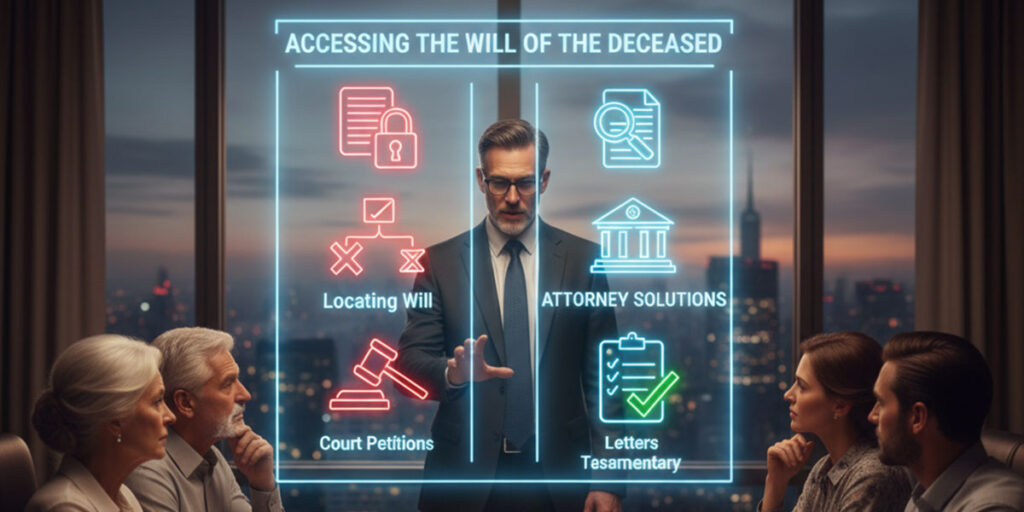
The period following a loved one’s passing brings immense grief and a multitude of responsibilities. Amidst this difficult time, discovering the deceased’s Last Will and Testament is missing or deliberately concealed can feel like an overwhelming legal roadblock. For families across New York, this common predicament often delays the crucial probate process, leaving them uncertain how to proceed.
You may know your parent or spouse executed a Will, perhaps even possessing a fuzzy photocopy. However, without the original document, you face significant legal hurdles. New York State law prohibits you from simply demanding access to a deceased person’s bank documents or compelling a reluctant relative to open a home safe. Accessing the Will demands formal, strategic legal intervention.
At Morgan Legal Group, our firm brings over three decades of experience successfully navigating the complexities of the New York Surrogate’s Court. We have handled more than 1,000 intricate estate planning and administration cases, earning over 900 positive online reviews for our commitment to resolving legal barriers for our clients. We understand the precise legal mechanisms an expert probate attorney uses to help you locate and access the Will of the deceased.
The New York “Original Will” Rule: Why Copies Fail
Before exploring methods for accessing a Will, it is vital to understand why finding the original is paramount. The New York Surrogate’s Court operates under a strict presumption: if the deceased was known to possess their original Last Will and Testament, and that original cannot be found after their death, the law presumes they intentionally destroyed it to revoke it. This is known as the “Presumption of Revocation.”
While an experienced estate planning attorney can sometimes probate a photocopy, this requires a highly complex evidentiary hearing, presenting substantial challenges. Therefore, securing physical access to the original, ink-signed document stands as your absolute first priority in estate administration.
Overcoming Obstacles: Where Your Loved One’s Will Might Reside
Locked Safe Deposit Boxes: The Catch-22 Solved by SCPA 2003
One of the most frequent places where Wills typically reside is a bank safe deposit box. This presents a frustrating paradox for families across New York. Consider David from Manhattan: his mother passed away, and he found the key to her Chase Bank safe deposit box. David went to the branch, expecting to retrieve the Will to be appointed Executor. The bank manager, however, demanded “Letters Testamentary” (the court document proving executorship) before granting entry. David could not obtain Letters Testamentary without the Will, which remained locked in the box.
When confronted with this situation, arguing with bank personnel proves futile. The solution lies in a specific legal petition. At Morgan Legal Group, we promptly file a petition under New York Surrogate’s Court Procedure Act (SCPA) Section 2003. This legal action compels the Surrogate’s Court to issue an “Order to Search,” directing the bank to open the safe deposit box in the presence of a bank officer. It is crucial to understand that this order is strictly limited in scope:
- You cannot remove jewelry, cash, or stock certificates.
- You can only remove the original Will, a deed to a burial plot, and life insurance policies.
- The bank officer directly mails the original Will to the Surrogate’s Court.
By utilizing SCPA 2003, we effectively breach the bank’s privacy wall and legally retrieve this foundational document for your family’s estate plan.
Uncooperative Family Members: Compelling Production with SCPA 1401
Sometimes, the Will resides in the home of an uncooperative family member. This unfortunate scenario often arises when a relative suspects the Will disinherits them or reduces their inheritance. Withholding a Will in New York constitutes a serious obstruction of justice; no individual has the right to hold an estate hostage.
To counter such actions, our attorneys invoke SCPA Section 1401. We initiate a proceeding to “Compel Production of a Will.” This process requires the uncooperative individual to appear before a Surrogate’s Court judge. They must either produce the original Will or provide sworn testimony regarding its whereabouts. Lying under oath carries severe legal consequences, including potential charges for perjury or even elder abuse, if applicable. The mere filing of this powerful petition often motivates the reluctant party to produce the hidden document, recognizing the serious legal repercussions they face.
The Drafting Attorney’s Vault: Navigating Attorney-Client Privilege
Many prudent New Yorkers entrust their original Wills and other vital estate documents to the law firm that drafted them, storing them securely in fireproof vaults. If you possess a photocopy or know the name of the attorney who prepared your loved one’s Will, this often provides the clearest path to recovery.
However, contacting the law firm directly can present a hurdle: attorney-client privilege. This privilege continues even after a client’s death, meaning the firm cannot simply hand over documents or even confirm their existence without proper legal authorization. As your legal representatives, we understand the protocols. We provide the drafting attorney with a certified death certificate and the necessary legal authorization to facilitate the secure transfer of the original Will. This document is then either delivered to our secure offices or directly to the Surrogate’s Court. Our firm also leverages its extensive professional network and resources from the New York State Bar Association to locate Wills when the original drafting attorney has retired or passed away, ensuring continuity.
Surrogate’s Court Safekeeping Vault
In less common instances, individuals proactively deposit their original Will with the local Surrogate’s Court for safekeeping during their lifetime. This measure offers robust protection against loss, damage, or tampering.
If we suspect this was the case, our dedicated probate team conducts a thorough search of the court’s indexes in the county where the deceased resided. Upon presenting the death certificate, the court transfers the Will from its safekeeping vault into the active probate process queue.
Wills Executed in a Hospital or Nursing Home
Wills signed in hospitals or nursing homes, often under urgent circumstances shortly before death, can present unique challenges for retrieval. These environments sometimes lead to misplaced documents or questions regarding the deceased’s capacity.
If a Will was signed within a medical facility, the administrative staff or social worker might have placed the original document in the patient’s file. We immediately issue formal legal demands to the facility to secure all relevant administrative records. Furthermore, if concerns arise about the deceased’s mental capacity at the time of signing, we can subpoena medical records to investigate potential undue influence or elder abuse, ensuring the Will’s validity.
The Dangers of DIY Estate Administration
Attempting to navigate the complexities of locating and securing a Will without professional legal assistance often leads to prolonged frustration, emotional distress, and potential financial loss. Financial institutions are legally bound to deny access to unauthorized individuals, and uncooperative relatives are unlikely to respond to informal requests. Without the legal authority of a court order or subpoena, you simply lack the necessary leverage.
When you engage Morgan Legal Group, you gain more than just legal paperwork processing; you secure zealous legal advocates. We deploy the full force of the New York State legal system to locate, secure, and validate your family’s essential estate planning documents. Our proactive and aggressive approach ensures that legal barriers are overcome efficiently.
Beyond the Will: Comprehensive Estate Document Retrieval
Finding the Will marks a critical first step, but a complete estate administration often requires access to a broader array of vital documents. A well-structured estate plan functions as an integrated system, and missing pieces can cause significant delays and complications.
Finding Trust Documents
If your loved one established a Revocable Living Trust to bypass probate, locating that original trust document is equally paramount. Unlike Wills, trust documents are private agreements and are not filed with the court. Our investigative strategies effectively uncover these original trust instruments, enabling the named Successor Trustee to assume control without court intervention.
Uncovering Financial Statements and Deeds
To accurately prepare the probate petition, we must also determine the estate’s overall value. If the deceased maintained private financial records, we act as diligent forensic investigators. Utilizing our legal authority, we compel banks, brokerage firms, and life insurance companies to release account balances. We also conduct comprehensive title searches across New York State to identify all real estate holdings.
Preventing Future Crises: The Power of Incapacity Planning
The most effective way to “access” a Will is to ensure it is never hidden or lost in the first place. At Morgan Legal Group, we champion proactive estate planning. We guide our clients in establishing secure, organized systems for their critical documents.
When we draft your Power of Attorney, Health Care Proxy, and Last Will and Testament, we provide clear, explicit instructions to your designated fiduciaries. We ensure your Executor knows precisely where all original documents are safely stored. By creating a transparent and meticulously organized estate plan, you spare your family the emotional burden and legal complexities of a document scavenger hunt during their time of mourning.
The Unmatched Value of Experience in New York Surrogate’s Court
The New York Surrogate’s Court operates under a highly specialized and intricate set of procedural rules. Even a minor error in a petition can lead to frustrating rejections and extensive delays, prolonging the probate process for months. You need a law firm with a deep understanding of both the administrative nuances and the assertive litigation tactics required to succeed.
Our firm’s extensive track record, including over 1,000 successful estate administration and planning cases, means we anticipate potential legal pitfalls and navigate them effectively. Should a family member contest the Will or challenge your appointment as Executor, our comprehensive experience in probate litigation and family law positions us to vigorously protect your rights in court. Furthermore, for estates involving complex elder law considerations, such as Medicaid liens or prior guardianship proceedings, our holistic approach efficiently addresses all interconnected legal challenges.
Turn Frustration into Legal Action
You cannot administer an estate effectively without the deceased’s clear instructions. If you are facing a locked safe deposit box, or if a family member is unjustly withholding your loved one’s Last Will and Testament, do not succumb to frustration. New York law provides powerful legal avenues to assert your rights, but activating these requires skilled legal counsel.
Partnering with an experienced legal team empowers you to compel the production of the Will, safeguard your family’s assets, and facilitate a smooth, peaceful transfer of wealth. Do not let bureaucratic hurdles or uncooperative individuals jeopardize your legacy. We urge you to schedule a consultation with Morgan Legal Group today. We are prepared to shoulder the legal burden, allowing you to focus on healing and your family. For immediate assistance with a hidden Will, please contact us directly. We stand ready to fight for your rightful access.
For further details on the statutory provisions for compelling the production of a Will, consult New York Surrogate’s Court Procedure Act (SCPA) Section 1401. You may also find valuable information on the New York Courts website regarding Surrogate’s Court processes.