Guiding Families Through Probate in Westchester County
Experiencing the loss of a loved one brings immense emotional challenges. Alongside grief, families often confront the daunting task of settling the deceased person’s affairs, a legal process known as probate. In Westchester County, like across New York State, probate is typically necessary to validate a will, appoint an executor, identify and value assets, satisfy debts and taxes, and ultimately distribute remaining property to beneficiaries.
Successfully navigating New York’s probate laws requires meticulous attention and a deep understanding of court procedures. At Morgan Legal Group, we recognize the sensitivity and complexity involved. Our team of seasoned attorneys, including dedicated professionals such as Russell Morgan, Esq., possesses extensive experience assisting families through these difficult transitions. We are committed to offering empathetic and knowledgeable legal counsel, ensuring your loved one’s estate receives administration with the utmost care and adherence to New York State law.
This comprehensive overview will clarify the Westchester probate process, detail essential steps, highlight potential obstacles, and demonstrate how a skilled probate lawyer becomes an invaluable ally. Our aim is to demystify legal complexities, providing clear, actionable insights that empower you during this trying period. We strive to ease your burden, allowing you to focus on healing and honoring cherished memories.
Understanding the Probate Process in New York
Probate serves as the legal framework for validating a deceased individual’s will and administering their estate. The New York Surrogate’s Court oversees this process. Its primary objectives include ensuring assets are distributed according to the deceased’s explicit wishes, as documented in their will, or, in the absence of a will, by New York’s intestacy statutes. Probate also establishes a formal mechanism for resolving outstanding debts, taxes, and administrative costs before assets pass to rightful heirs or beneficiaries.
Even seemingly straightforward estates can present intricate legal demands. The court must confirm the will’s authenticity and verify the testator’s mental capacity at the time of signing. Furthermore, the appointed executor assumes significant responsibilities, which include locating all assets, filing necessary court documents, notifying creditors, and meticulously accounting for all transactions. Without expert legal guidance, these duties can become overwhelming and lead to potential disputes or costly errors.
The probate journey typically commences with filing a petition with the Surrogate’s Court. This petition formally requests the court to accept the will for probate and appoint the designated executor. All interested parties, including legal heirs and beneficiaries, must receive proper notification. Following review, the court issues Letters Testamentary, granting the executor the legal authority essential for managing estate assets, such as selling property or accessing bank accounts.
The Indispensable Role of a Westchester Probate Attorney
Engaging a proficient probate attorney in Westchester County often represents one of the most crucial decisions a family makes during estate administration. At Morgan Legal Group, our role extends far beyond routine paperwork. We serve as your trusted advisors, unwavering advocates, and expert navigators through a system that can feel profoundly intimidating. We provide clarity, strategic counsel, and robust legal representation at every juncture.
A dedicated probate attorney will:
- Assess whether probate is necessary for the specific estate.
- Prepare and submit all required legal documents to the Westchester County Surrogate’s Court.
- Locate and help secure all estate assets.
- Notify creditors and manage the payment of estate debts and applicable taxes.
- Address any potential challenges to the will, such as allegations of undue influence or questions regarding testamentary capacity.
- Represent the estate during court proceedings, if required.
- Guide the executor in fulfilling their critical fiduciary duties.
- Facilitate the precise and timely distribution of assets to beneficiaries.
Our profound familiarity with Westchester Surrogate’s Court procedures enables us to anticipate potential obstacles and address them proactively. We understand local court practices and the specific requirements of judges presiding over probate matters. This localized insight, coupled with our extensive legal expertise, ensures your case progresses efficiently and effectively. Our primary goal remains minimizing stress for you and your family, allowing you to focus on healing and remembrance.
Key Stages in the Westchester Probate Journey
The probate process in Westchester County follows a structured, though sometimes protracted, sequence. Understanding each stage helps manage expectations and prepares you for the tasks ahead. While every estate presents unique details, the general framework remains consistent:
1. Initiating the Probate Petition
Upon an individual’s passing, the initial formal action typically involves filing a Petition for Probate with the Westchester County Surrogate’s Court. If the deceased left a valid will, this petition names the executor designated within it. In cases without a will, the court references New York’s intestacy laws to determine who possesses the right to administer the estate, usually a close relative. Our firm ensures this petition is accurate and complete, thereby preventing unnecessary delays.
2. Informing Interested Parties
After filing the petition, New York law mandates formal notification to all interested parties regarding the probate proceedings. This group includes the nominated executor, all beneficiaries named in the will, and the distributees (legal heirs) who would inherit if no will existed. Our attorneys meticulously manage the service of these notices, ensuring full legal compliance. This notification process safeguards transparency and allows any individual with a valid objection to present their concerns.
3. Court Review and Will Validation
The Surrogate’s Court meticulously reviews the petition and all supporting documentation. If all elements are in order and no objections arise, the court formally admits the will to probate. This represents a pivotal moment, as it legally validates the will as the deceased’s definitive final wishes. For estates within Westchester, this step signifies the court’s official recognition of the will’s authenticity and the executor’s appointment.
4. Obtaining Letters Testamentary or Administration
Upon admitting the will, the court issues “Letters Testamentary” to the named executor. If no will exists, the court issues “Letters of Administration” to the appointed administrator. These crucial legal documents function as the executor’s or administrator’s official credentials, granting them the legal authority to act on behalf of the estate. This authority is indispensable for accessing bank accounts, transferring property titles, and settling debts. Without these letters, the executor cannot legally manage estate assets.
5. Identifying and Valuing Estate Assets
With proper legal authority, the executor, guided by their attorney, commences the thorough process of identifying, locating, and valuing all assets owned by the deceased. This can encompass real estate, bank accounts, investment portfolios, personal belongings, and digital assets. A comprehensive inventory is vital for court records and tax purposes. Our team helps ensure no asset is overlooked and that accurate valuations are obtained.
6. Managing Debts and Taxes
A critical responsibility of the executor involves paying the deceased’s outstanding financial obligations, including mortgages, credit card balances, medical bills, and taxes. This necessitates notifying known creditors and publishing a legal notice to inform any unknown creditors. New York estate taxes may also apply, depending on the estate’s size. We assist in navigating this complex phase, ensuring all obligations are met precisely and promptly, and that any applicable estate tax filings are handled professionally. For further information on New York estate tax, consult the New York State Department of Taxation and Finance.
7. Distributing Remaining Assets
Once all debts, taxes, and administrative expenses have been satisfied, the remaining assets are distributed to the beneficiaries according to the will’s directives or New York’s intestacy laws. This often entails preparing a formal accounting for both the court and the beneficiaries. The final step involves the formal discharge of the executor once all distributions are complete. Our objective is to ensure this final distribution is executed accurately and efficiently, bringing the probate process to a conclusive end.
Navigating Common Probate Challenges in Westchester
While the probate process aims for orderliness, it does not always proceed without complications. Several common challenges can emerge, particularly within a diverse and complex region like Westchester. Recognizing these potential issues early enables the development of proactive legal strategies to mitigate their impact.
Will Contests
One of the most significant challenges involves a will contest. Individuals may challenge a will on various grounds, including:
- Lack of testamentary capacity: The deceased lacked the mental ability to comprehend they were creating a will.
- Undue influence: Someone improperly pressured the deceased to alter their will.
- Fraud: The will was signed based on deceptive information.
- Improper execution: The will failed to meet New York’s strict legal requirements for signing or witnessing.
Should a will face a contest, the probate process can experience substantial delays, and legal fees may escalate. Our firm possesses extensive experience in both defending and pursuing will contests, striving to resolve these disputes fairly and efficiently, often through negotiation or, when necessary, litigation.
Complex Asset Structures
Estates in Westchester frequently involve intricate assets, such as multiple properties, business interests, or substantial investment portfolios. Valuing and managing these assets demands specialized knowledge. For instance, a business interest may require an independent appraisal, and real estate might necessitate sale or transfer, often involving complex title work. We collaborate with financial and real estate professionals to ensure these assets receive proper handling.
Ambiguous Will Provisions
Occasionally, a will’s language can appear unclear or ambiguous, leading to differing interpretations among beneficiaries or the executor. This can ignite disputes regarding the deceased’s true intentions. Our attorneys are adept at interpreting legal documents and can assist the court in clarifying any ambiguous provisions to ensure the will is executed precisely as the testator intended. Proactive estate planning often prevents such ambiguities from arising.
Discovery of Additional Assets or Debts
It is not uncommon for new assets or previously unknown debts to emerge during the probate process. This requires updating court filings and potentially re-evaluating the estate’s overall financial picture. Our team is skilled at managing these evolving circumstances and ensuring all legal requirements are met as new information comes to light.
Executor Responsibilities and Fiduciary Duties
Executors carry significant legal responsibilities known as fiduciary duties. They must act with honesty, diligence, and always in the best interest of the estate and its beneficiaries. Mismanagement or failure to adhere to these duties can expose the executor to personal liability. We provide clear guidance to executors, helping them understand and fulfill their obligations, thereby safeguarding them from potential legal repercussions.
Dealing with Out-of-State or International Assets
If the deceased owned property or maintained bank accounts in other states or countries, the probate process can become considerably more complex. Ancillary probate proceedings may become necessary in those additional jurisdictions. Our firm can coordinate with legal counsel in other locations to ensure a comprehensive and efficient administration of all the deceased’s assets, irrespective of their geographical location. This holistic approach proves crucial for effective estate planning.
Probate vs. Non-Probate Assets: A Clear Distinction
It is crucial to understand that not all assets owned by a deceased individual are subject to the probate process. Certain assets directly transfer to beneficiaries outside of probate, commonly referred to as non-probate assets. Identifying these assets is essential for accurately assessing the scope of the probate estate and for effective estate planning.
Assets That Typically Bypass Probate Include:
- Assets held in trust: Property placed within a trust, such as a revocable living trust, generally avoids probate. The successor trustee distributes these assets according to the trust’s specific terms. This represents a primary advantage of incorporating trusts into an estate plan.
- Jointly owned property with rights of survivorship: Real estate or bank accounts held by co-owners with “rights of survivorship” automatically transfer to the surviving owner upon the death of one owner.
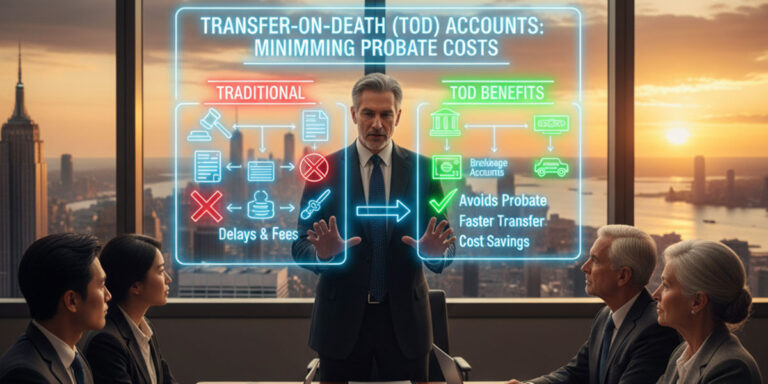
- Accounts with Payable on Death (POD) or Transfer on Death (TOD) designations: Bank accounts, brokerage accounts, and retirement accounts (like IRAs and 401(k)s) with designated beneficiaries bypass probate. The financial institution directly transfers these assets to the named beneficiaries.
- Life insurance proceeds: Life insurance policies with a named beneficiary pay out directly to that individual, separate from the probate estate.
Conversely, probate assets are those owned solely by the deceased at the time of their passing, without a named beneficiary or survivorship rights, and not held within a trust. Examples include individual bank accounts, solely owned real estate, vehicles titled exclusively in the deceased’s name, and personal property not specifically designated to pass to a particular person. Our firm assists clients in discerning which assets will undergo probate and which will not, a vital component of effective estate planning and simplifying the overall process.
Why Choose Our Westchester Probate Firm
Navigating the probate process in Westchester County demands a profound grasp of New York law, local court procedures, and a genuinely compassionate approach. At Morgan Legal Group, we proudly offer precisely this blend of expertise. Our dedicated team is committed to guiding you through every step of this challenging journey with proficiency, efficiency, and deep empathy.
We understand that each estate presents unique circumstances. Whether your situation involves a straightforward will, a complex trust, potential will contests, or the need for guardianship proceedings, we possess the experience to handle it. Our attorneys are highly skilled in the intricacies of Westchester Surrogate’s Court and boast a proven record of successfully settling estates for families throughout the county. We stand ready to answer your questions, alleviate your concerns, and vigorously advocate for your best interests.
When you select Morgan Legal Group, you choose a team that prioritizes clear communication and personalized service. We believe in keeping our clients fully informed at every stage, explaining legal options in accessible language, and collaborating to achieve the optimal outcome. Our objective remains making the probate process as stress-free as possible for you and your family.
We also recognize the critical importance of proactive estate planning. By understanding the probate process and its potential challenges, you can take decisive steps now to ensure your own affairs are in order, simplifying matters for your loved ones when the time comes. This includes drafting clear and comprehensive wills, establishing trusts, and setting up essential documents like a Power of Attorney and healthcare directives.
Proactive Estate Planning for Your Future in Westchester
While this discussion focuses on probate, it is crucial to acknowledge that the most effective way to simplify the process for your heirs involves comprehensive estate planning. Proactive planning can significantly reduce the burden on your family, prevent costly disputes, and ensure your assets are distributed precisely according to your wishes. In Westchester County, as throughout New York State, meticulous planning is paramount.
A thoughtfully constructed estate plan often incorporates several key documents:
- Last Will and Testament: This foundational document names an executor to manage your estate and specifies how your assets will be distributed. A clear will can avert expensive litigation and ensure your final wishes are honored.
- Trusts: Various trust types, such as revocable living trusts or irrevocable trusts, can manage assets during your lifetime and distribute them to beneficiaries upon your death, frequently bypassing the probate process entirely. This serves as a powerful instrument for asset protection and probate avoidance.
- Durable Power of Attorney: This document designates an individual to make financial and legal decisions on your behalf should you become incapacitated. This is vital for managing your affairs without the need for a court-appointed guardianship.
- Health Care Proxy and Living Will: These documents articulate your wishes regarding medical treatment and appoint someone to make healthcare decisions if you are unable to do so yourself.
At Morgan Legal Group, we specialize in crafting tailored estate plans for individuals and families in Westchester. Our estate planning attorneys collaborate closely with you to understand your unique financial situation, family dynamics, and long-term goals. We then develop a comprehensive plan designed to protect your assets, minimize taxes, and provide invaluable peace of mind for you and your loved ones. We also offer expertise in elder law, ensuring your plan addresses potential long-term care needs. For more general information on estate planning, the New York State Bar Association provides valuable resources.
Consider a family in Westchester with significant real estate holdings and diverse investments. Without proper planning, these assets could remain entangled in probate for years, incurring substantial costs. By establishing a trust, for instance, these assets can transfer to beneficiaries efficiently and with minimal court intervention. Moreover, effective planning can address potential issues such as elder abuse or the need for long-term care by incorporating specific provisions and protections.
Whether you are initiating an estate plan or require updates to an existing one, our firm is equipped to guide you. We understand that estate planning is not a singular event but an ongoing process that should adapt to life’s changes. We are committed to providing you with the knowledge and legal instruments necessary to secure your future and the future of your loved ones.
Selecting Your Probate Counsel in Westchester
Choosing the appropriate probate lawyer in Westchester County represents a decision that profoundly influences the smoothness and outcome of the estate administration process. It extends beyond merely finding someone with legal credentials; it involves identifying a partner who comprehends the emotional weight of your situation and can navigate legal complexities with both expertise and empathy.
When evaluating potential attorneys, look for the following essential qualities:
- Specialized Experience: The lawyer should possess a deep understanding of New York’s Surrogate’s Court Procedures Act and a proven history of managing probate matters specifically within Westchester County. Local knowledge is an invaluable asset.
- Clear Communication: The attorney must articulate complex legal concepts in an easily understandable manner. They should respond promptly to your questions and keep you fully informed throughout the process.
- Empathy and Compassion: Dealing with probate invariably occurs during a period of grief. A compassionate attorney will acknowledge this and approach your case with sensitivity and patience.
- Meticulous Attention to Detail: Probate involves precise legal documentation and strict deadlines. An attorney with scrupulous attention to detail is indispensable to prevent errors that could cause delays or complications.
- Transparent Fee Structure: Discuss fees upfront. Understand how the attorney charges (hourly, flat fee, or contingency) and precisely what services are included.
At Morgan Legal Group, we embody these crucial qualities. Our team, spearheaded by experienced attorneys like Russell Morgan, Esq., brings decades of combined experience in estate administration, wills, and trusts to every case. We are dedicated to providing personalized legal counsel that directly addresses your specific needs and concerns. We manage everything from routine probate filings to complex estate litigation, consistently aiming to achieve the best possible outcome for our clients and their families.
We understand the profound trust you place in us during such a vulnerable time. Our firm is committed to upholding that trust through unwavering integrity, professionalism, and a relentless dedication to your family’s well-being. We function not merely as legal representatives; we serve as partners who will accompany you every step of the way. For those in Westchester, navigating the intricacies of probate and estate law can feel overwhelming, but with the right legal guidance, it transforms into a manageable process.
Connect with Our Westchester Probate Team
The probate process in Westchester County, while inherently complex, becomes manageable with the right legal support. If you are facing the administration of a loved one’s estate or seek to secure your own future through robust estate planning, Morgan Legal Group stands ready to assist. Our team possesses the experience, knowledge, and compassionate approach necessary to guide you through these critical legal matters.
We understand the emotional and financial pressures accompanying loss and legal proceedings. Our commitment is to provide clarity, peace of mind, and effective legal representation to protect your interests and honor the legacy of your loved ones. We offer comprehensive services covering every aspect of probate, from initial filing to final distribution, and proactive wills and trusts to safeguard your family’s future.
Do not attempt to navigate the complexities of Westchester probate law alone. Allow our seasoned attorneys to provide the expert guidance and support you truly need. We dedicate ourselves to ensuring your rights are protected and that your estate, or that of your loved one, receives efficient administration with the utmost care.
We invite you to contact us today to discuss your specific situation. You can also schedule a consultation with one of our experienced Westchester probate lawyers. Let Morgan Legal Group be your trusted advocate during this challenging time. For additional information and client reviews, please visit us on Google My Business.