Experiencing the loss of a loved one brings profound grief. Amidst this difficult time, families often face the daunting task of settling the deceased’s estate. For residents of Westchester County, understanding the legal process known as probate becomes essential. This process ensures assets transfer correctly and debts are managed according to law. Navigating these complexities requires clear guidance and expert support to achieve peace of mind.
Probate is the court-supervised procedure that validates a will, identifies and values assets, settles outstanding debts and taxes, and ultimately distributes the remaining property to rightful beneficiaries. In New York, the Surrogate’s Court oversees this process, with Westchester County’s proceedings handled in White Plains. Without knowledgeable legal assistance, families can encounter significant delays, costly mistakes, and unnecessary stress. This highlights the indispensable role of a skilled probate lawyer in Westchester County.
At Morgan Legal Group, we recognize the sensitivity involved in estate matters. With over three decades of dedicated experience, we guide families through these challenging periods. Our commitment lies in providing compassionate, effective legal representation, ensuring your loved one’s estate receives meticulous care and efficient resolution. We aim to alleviate your burden, allowing you to focus on healing and honoring their memory.
Understanding New York State’s Probate Process
New York State governs its probate process through specific legal procedures, which begin after an individual’s passing. Typically, the executor named in the decedent’s Last Will and Testament initiates this journey. If no will exists, the court appoints an administrator. Both roles carry significant responsibility, requiring adherence to court supervision throughout the estate’s administration.
The initial step involves filing the will (if one exists) with the Surrogate’s Court, a procedure known as a probate petition. The court then issues ‘Letters Testamentary’ to the executor, granting them legal authority to act on behalf of the estate. In cases without a will (an ‘intestate’ situation), the court issues ‘Letters of Administration’ to an appointed administrator. These official documents are crucial for accessing estate assets and managing liabilities.
Key stages in the New York probate process include:
- Filing the probate petition and the original will (if applicable).
- Notifying all beneficiaries and legal heirs.
- Compiling a comprehensive inventory and appraising all estate assets.
- Paying legitimate debts, taxes, and administrative expenses.
- Distributing the remaining assets to beneficiaries as outlined in the will or New York’s intestacy laws.
Each stage demands precise attention to detail and strict adherence to legal deadlines. For instance, creditors have a specific window to file claims against the estate. Missing these deadlines can lead to severe financial repercussions. Therefore, professional legal oversight proves invaluable.
When Is Probate Necessary in Westchester County?
Not every estate automatically enters the full probate process. The necessity of probate in Westchester County largely depends on the types of assets the decedent owned and how these assets were legally titled. Certain assets are designed to bypass probate entirely, offering a smoother transfer of ownership.
Assets that typically avoid probate include:
- Property held within a properly funded living trust.
- Life insurance policies with designated beneficiaries.
- Retirement accounts (e.g., IRAs, 401(k)s) that name specific beneficiaries.
- Jointly owned property with rights of survivorship (e.g., joint bank accounts, real estate).
- Assets with pay-on-death (POD) or transfer-on-death (TOD) designations.
However, if the decedent owned assets solely in their name, such as real estate, individual bank accounts, or stocks without beneficiary designations, these assets generally require probate. The total value of these probate assets also influences the process. New York law provides simplified procedures for small estates, which can significantly reduce the time and cost compared to formal probate. Our team can help determine if probate is required for your loved one’s estate and explore strategies to minimize or avoid it where legally permissible. We possess expertise in navigating the complexities of estate asset titling and distribution.
The Responsibilities of an Executor or Administrator
The executor (when a will exists) or administrator (when no will exists) serves as the central figure in the probate process. Appointed by the Surrogate’s Court, they manage the estate, a role demanding diligence, impartiality, and a thorough understanding of legal obligations. The executor’s duties are extensive and can include:
- Locating and safeguarding the decedent’s will.
- Obtaining ‘Letters Testamentary’ or ‘Letters of Administration’ from the court.
- Identifying, inventorying, and securing all estate assets.
- Arranging for professional appraisals of real estate and other valuable property.
- Establishing an estate bank account for financial transactions.
- Paying funeral expenses, outstanding debts, and legitimate claims against the estate.
- Filing the decedent’s final income tax returns and, if applicable, estate tax returns.
- Distributing remaining assets to beneficiaries or heirs according to legal directives.
- Providing a detailed accounting of all estate transactions to the court and beneficiaries.
Serving as an executor or administrator can be both time-consuming and legally intricate. The role often involves making difficult decisions, such as resolving contested debts or disputes among beneficiaries. Furthermore, executors face potential personal liability for any mismanagement of the estate. This underscores the critical importance of seeking legal counsel. A seasoned probate attorney offers invaluable guidance, helping executors fulfill their duties correctly and avoid potential legal pitfalls. We provide comprehensive support to both executors and administrators throughout the entire process.
How a Probate Lawyer in Westchester County Provides Essential Support
Engaging a qualified probate lawyer in Westchester County offers numerous advantages during a challenging time. Morgan Legal Group specializes in guiding families through the probate process with expertise and empathy. We possess a deep understanding of local court procedures and the nuances of New York estate law, ensuring a smoother, more efficient, and legally sound resolution for the estate.
Our experienced team assists clients by:
- Guiding the Petition Process: We prepare and file the necessary probate petition with the Westchester County Surrogate’s Court, ensuring all legal requirements are met accurately and promptly.
- Asset Identification and Valuation: We help identify all estate assets and assist in securing professional appraisals for complex holdings like real estate or business interests, crucial for accurate estate valuation and tax filings.
- Debt and Creditor Management: Our team manages the process of notifying creditors, reviewing claims, and facilitating the payment of valid debts against the estate, adhering strictly to statutory notice periods.
- Tax Compliance: We advise on and assist with the preparation of necessary estate and inheritance tax returns, clarifying New York estate tax thresholds and federal estate tax implications.
- Will Interpretation and Contests: In cases of unclear will provisions or disputes, we offer expert interpretation and represent clients in will contest proceedings, advocating for their rights and the integrity of the will.
- Beneficiary Distribution: We ensure assets are distributed to the rightful beneficiaries in accordance with the will or New York intestacy laws, including preparing final accountings and distribution decrees.
- Dispute Resolution: Probate can sometimes involve disagreements among beneficiaries or between beneficiaries and executors. We are skilled negotiators and litigators, striving to resolve disputes efficiently and amicably.
- Navigating Complex Situations: Estates often present unique challenges, such as business interests, foreign assets, or significant debt. We have the experience to handle these complexities effectively.
Our primary goal is to alleviate the stress associated with probate, protecting your interests and those of your loved ones. We provide clear communication and strategic advice at every stage. Consider contacting our firm to discuss your specific situation and learn how we can assist you.
Common Hurdles in Westchester Estate Administration
While the probate process aims for fairness and order, it often presents various challenges. Even seemingly straightforward estates can encounter complications. In Westchester County, these hurdles can arise from multiple factors. Understanding these common issues helps families prepare and mitigate potential problems.
One frequent challenge involves the precise identification and accurate valuation of assets. Estates can comprise a wide array of property, from real estate and bank accounts to unique collections or business interests. Proper valuation is critical for tax purposes and for ensuring equitable distribution among heirs. This process can become complicated by fluctuating market values or the need for specialized appraisals.
Creditor claims represent another significant hurdle. New York law grants creditors a specific period to file claims against an estate. The executor must meticulously review these claims, ensuring only valid debts receive payment. Disputes over a debt’s validity can lead to litigation, and insufficient assets to cover all debts can create further complications. A knowledgeable probate lawyer can skillfully navigate these creditor issues.
Will contests also frequently lead to probate disputes. A will may face challenges based on grounds such as lack of testamentary capacity, undue influence, or improper execution. Such contests can significantly prolong the probate process and often result in expensive litigation. Our team possesses extensive experience in handling will contests, working to protect the will’s integrity or representing the interests of those challenging it.
Complex family dynamics can further complicate estate administration. Disputes among beneficiaries, estranged family members, or ambiguous provisions within the will can create friction. Moreover, situations involving minor beneficiaries or those with special needs require careful planning and court oversight. Our firm prioritizes clear communication and fair resolution, aiming to preserve family harmony whenever possible.
Finally, delays can occur due to court backlogs or incomplete documentation. The Westchester County Surrogate’s Court, like others, manages a high volume of cases. Missing paperwork or procedural errors can add weeks or even months to the probate timeline. Proactive legal representation helps prevent these delays by ensuring all necessary documents are filed correctly and on time, which is crucial for an efficient probate process.
Understanding New York Estate Taxes
Understanding estate taxes forms a critical component of the probate process. In New York, both federal and state estate taxes may apply. The federal estate tax exemption remains quite high, meaning most estates do not incur federal estate taxes. However, New York State maintains its own estate tax exemption, which has increased in recent years. Staying informed about the current thresholds is vital. For 2026, the New York State estate tax exemption applies to estates valued over $6.5 million, though this figure is subject to change. The New York State Department of Taxation and Finance provides current guidance.
An estate tax return, typically Form ET-706, becomes mandatory if the gross estate exceeds the New York exemption amount. The ‘gross estate’ encompasses all assets owned by the decedent at the time of death, including assets that pass outside of probate, such as life insurance proceeds and retirement accounts, under certain conditions. Accurately calculating the gross estate requires careful consideration of all assets and potential deductions.
Deductions can significantly reduce an estate’s taxable value. Common deductions include the decedent’s debts, funeral expenses, administrative costs of the estate, and bequests to surviving spouses or qualified charities. A skilled probate lawyer can help identify all eligible deductions, potentially lowering the estate’s tax liability substantially. This area of law is complex, and professional advice is highly recommended to ensure compliance and optimize tax outcomes. Our team at Morgan Legal Group possesses extensive experience in estate tax planning and compliance, guiding you through the complexities of estate tax law to ensure your estate’s tax obligations are met accurately and efficiently, often coordinating with tax professionals when necessary.
Probate Alternatives: The Power of Trusts
When discussing estate settlement, comparing the probate process with the strategic use of trusts is common. Both serve as estate planning tools, yet they function distinctly. Grasping these differences is key to making informed decisions about managing your assets during your lifetime and after your passing. Our firm offers comprehensive estate planning services, helping clients determine the optimal approach for their unique circumstances.
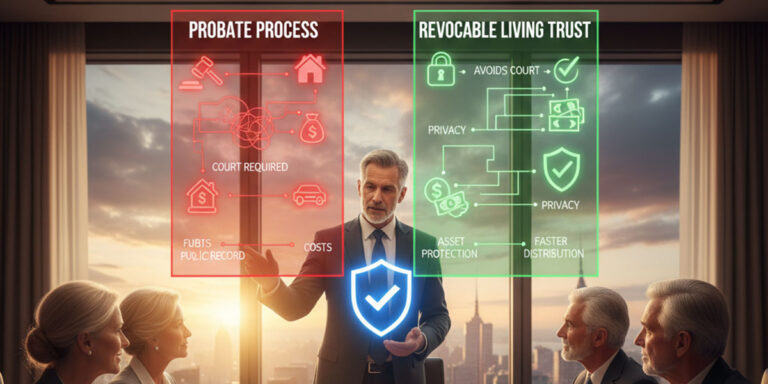
As previously discussed, probate is a court-supervised legal process generally required for assets owned solely by the decedent that do not automatically transfer to beneficiaries. Probate can be time-consuming, costly, and publicly accessible, meaning the details of your assets and beneficiaries become public record.
In contrast, a trust, particularly a revocable living trust, aims to avoid probate. Assets transferred into a living trust during your lifetime are managed by a trustee (often yourself during your lifetime) for the benefit of designated beneficiaries. Upon your death, the successor trustee you appointed takes control and distributes the trust assets according to the trust’s terms. This process is typically private and significantly faster than probate, bypassing the court system entirely.
Various types of trusts exist, each serving distinct purposes. Revocable living trusts are popular for their probate avoidance benefits, while irrevocable trusts can offer enhanced asset protection and tax advantages. A significant benefit of using trusts is the privacy they afford; the trust’s terms and asset distribution remain confidential. This proves particularly important for individuals seeking to keep their financial affairs private. While trusts offer substantial advantages, they also involve upfront costs and require diligent administration. Assets must be correctly transferred into the trust for it to be effective. Our attorneys are skilled in drafting and administering various types of trusts, helping you understand if a trust is the right vehicle for your estate and guiding you on integrating trusts into a comprehensive estate plan. This might also involve creating wills that complement your trust structure. Visit our Wills and Trusts page to learn more.
Proactive Planning: Elder Law, Guardianship, and Asset Protection
As individuals age, their needs and circumstances evolve. Elder law addresses these changing requirements, encompassing a broad spectrum of legal issues. These include estate planning, healthcare decision-making, financial management, and protection against abuse. For seniors and their families in Westchester County, understanding elder law is crucial for ensuring well-being and preserving autonomy.
A cornerstone of elder law involves planning for potential incapacity. Documents like a Durable Power of Attorney and a Health Care Proxy become vital in this regard. A Power of Attorney allows you to designate a trusted individual to manage your financial affairs if you become unable to do so. A Health Care Proxy designates someone to make medical decisions on your behalf. These proactive measures are far preferable to guardianship proceedings, which can be costly and intrusive.
However, if a person becomes incapacitated without having established these planning documents, a court may need to appoint a guardian. Guardianship proceedings, sometimes called conservatorship, are legal actions initiated to appoint a guardian to make decisions for an individual who can no longer make them for themselves. In New York, the Supreme Court handles these proceedings. A guardian can manage the incapacitated person’s finances (guardian of the property) or make personal and healthcare decisions (guardian of the person).
Guardianship represents a complex and emotionally charged process. It requires demonstrating to the court that the individual is indeed incapacitated and that guardianship is the least restrictive means to provide care and protection. The court appoints a guardian based on what it deems to be in the ward’s best interests. This lengthy and expensive process underscores why proactive estate planning, including the creation of Powers of Attorney and Health Care Proxies, holds such importance. Our team has extensive experience in NYC Elder Law and guardianship matters, helping clients navigate these sensitive issues with care.
Safeguarding Vulnerable Seniors: Addressing Elder Abuse
Elder abuse constitutes a serious concern, encompassing physical, emotional, sexual, and financial mistreatment of older adults, alongside neglect and exploitation. Sadly, seniors often become vulnerable targets due to reliance on caregivers, cognitive decline, or isolation. Identifying and addressing elder abuse is critical for protecting seniors’ safety, dignity, and financial security.
Financial exploitation stands as a prevalent form of elder abuse, involving the illegal or improper use of an older person’s funds, property, or assets. Perpetrators can include family members, caregivers, strangers, or even professionals. Many instances of financial exploitation go unreported due to fear, shame, or the victim’s inability to communicate the abuse. The U.S. Department of Justice offers resources on this critical issue.
Physical abuse involves the intentional use of force resulting in pain, injury, or impairment. Emotional abuse causes mental anguish or distress. Neglect occurs when a caregiver fails to provide necessary care, food, shelter, or medical attention. Recognizing the signs of elder abuse is the first step toward intervention. These signs may include unexplained injuries, sudden changes in behavior or mood, significant financial discrepancies, or the isolation of the elder.
If you suspect elder abuse, taking immediate action is crucial. New York provides protective laws and agencies designed to help. Reporting suspected abuse to Adult Protective Services (APS) or local law enforcement is essential. For cases involving financial exploitation or undue influence related to estate matters, legal intervention may be necessary. A lawyer specializing in elder abuse can help protect the victim’s rights and recover stolen assets. Morgan Legal Group is committed to protecting the rights and well-being of seniors. We understand the devastating impact of elder abuse and provide legal counsel and advocacy for victims and their families. If you have concerns about elder abuse in Westchester County, please do not hesitate to reach out to us for confidential assistance. We are here to help safeguard our most vulnerable citizens.
The Consequences of Dying Without a Will (Intestacy)
When an individual passes away without a valid will, they are said to have died ‘intestate.’ In such circumstances, New York State law dictates how the deceased person’s assets will be distributed. This is governed by the laws of intestacy. The probate process for an intestate estate often becomes more complex, involving the identification of legal heirs and strict adherence to a statutory framework for asset distribution.
In New York, if you die intestate, your assets are distributed according to a specific hierarchy. For example, if you are survived by a spouse but no children, your spouse generally inherits your entire estate. If you are survived by a spouse and children, the spouse typically receives the first $50,000 of the estate and one-third of the remainder, with the remaining two-thirds going to the children. If you have no surviving spouse or children, the estate typically passes to parents, siblings, and other more distant relatives according to a statutory order.
The administrator appointed by the court in an intestate situation must be a qualified individual who follows these statutory rules precisely. This means they cannot deviate based on what they believe the deceased might have wanted. This can lead to outcomes that do not align with the deceased’s actual wishes or family dynamics. For instance, a close friend or a specific charity the deceased intended to benefit may receive nothing.
Identifying all legal heirs can be challenging, potentially involving tracing family lineage and locating individuals who may be unaware of their inheritance. This can significantly prolong the probate process. Moreover, disputes among potential heirs regarding distribution can lead to costly litigation. This underscores why having a will is so crucial. A well-drafted will ensures your assets are distributed according to your specific wishes, providing clarity and avoiding the uncertainties of intestacy laws. Our firm strongly advises all individuals to create a will as a fundamental part of responsible estate planning. If you are dealing with an intestate estate in Westchester County, our experienced attorneys can guide you through the process, helping identify heirs, navigate court procedures, and ensure the estate settles fairly and according to law. We understand the complexities of intestacy and provide clear, compassionate guidance.
Secure Your Future with a Durable Power of Attorney
A Durable Power of Attorney (POA) stands as a critical legal document. It empowers you to appoint a trusted individual to manage your financial affairs should you become unable to do so yourself. This document proves essential for avoiding the need for a court-appointed guardianship. A ‘durable’ power of attorney remains effective even if you become incapacitated, a key distinction from a non-durable POA.
Without a durable POA, if you become incapacitated, your loved ones may need to petition the court for guardianship. As previously mentioned, this can be a lengthy, costly, and public process. It also means a judge, rather than you, will decide who manages your finances and holds authority over your affairs. A properly executed durable POA grants significant power to your chosen agent, which can include managing bank accounts, paying bills, selling property, and accessing investments.
Choosing the right agent is paramount. This person should be trustworthy, responsible, and capable of handling financial matters. Clearly defining the scope of the agent’s authority is also important; you can grant broad powers or limit them to specific transactions. Furthermore, you can specify when the POA becomes effective—either immediately or ‘springing’ into effect upon your incapacitation, as certified by a physician.
At Morgan Legal Group, we emphasize the importance of durable POAs as part of any comprehensive estate plan. They serve as a vital tool for ensuring your financial well-being and that of your family in the event of unforeseen circumstances. We help clients draft POAs that align with their specific needs and wishes. This proactive step can save your family immense stress and expense down the line. We also advise on the proper execution and secure storage of these important documents. The need for such documents is underscored when dealing with the complexities of settling an estate. A well-structured Power of Attorney can simplify many financial tasks involved in the probate process, ensuring continuity in managing assets and liabilities, which proves particularly beneficial for estates undergoing formal probate proceedings.
Your Trusted Partner for Estate Matters in Westchester County
Morgan Legal Group is deeply committed to serving the families of Westchester County. We understand the unique legal landscape and community needs of this area. With over three decades of experience, our firm has built a reputation for providing knowledgeable, compassionate, and results-driven legal services. We dedicate ourselves to helping our clients navigate some of life’s most challenging legal matters.
Whether you are planning for the future through estate planning, managing the complexities of a loved one’s probate, or seeking to protect an elder’s rights, our team stands ready to assist you. We believe in personalized legal strategies, taking the time to understand each client’s unique situation. This approach allows us to provide tailored advice and representation that truly meets your needs.
We recognize that dealing with legal issues related to death, incapacity, or inheritance can be emotionally draining. Our attorneys approach every case with empathy and respect, striving to make the legal process as clear and stress-free as possible. We aim to empower our clients with knowledge and confidence throughout their legal journey.
Our firm’s principal attorney, Russell Morgan, Esq., brings a wealth of experience and dedication to upholding the highest standards of legal practice. We proudly serve the Westchester community, committed to protecting your family’s legacy and ensuring your legal needs are met with expertise and integrity. If you are facing a legal challenge related to estate planning, probate, or elder law in Westchester County, we encourage you to contact us. We offer a confidential consultation to discuss your concerns and explore your legal options. Let us be your trusted legal partners during this important time. We are ready to provide the guidance and support you need to achieve peace of mind. Consider scheduling a consultation with us today.
For those in the broader New York City area, our commitment extends to serving clients throughout the five boroughs. Our comprehensive understanding of New York law ensures we can effectively represent clients regardless of their specific location within our service area.