
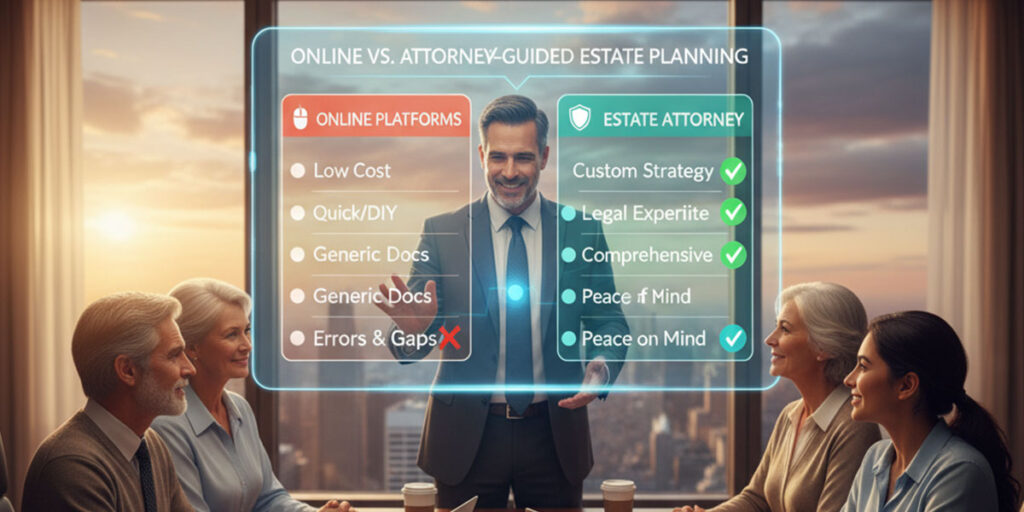
We live in an era of unparalleled convenience. You can buy groceries, trade stocks, and even buy a car from your smartphone. Consequently, the internet is flooded with websites offering “fast, cheap, and legal” estate planning documents for as little as $99. The marketing is incredibly persuasive. They promise that answering a few automated questions will secure your family’s future.
As a New York City attorney, I understand the appeal. Everyone wants to save time and money. However, convenience often comes at a catastrophic cost.
I am Russel Morgan, founder of Morgan Legal Group. Over the past 30 years, our firm has handled over 1,000 successful cases. We have also earned over 900+ positive online reviews by rescuing families from legal disasters. Many of those disasters started with a cheap, online legal form.
In New York State, estate planning is not a data-entry task. It is a highly strategic, customized architectural process. The laws governing the New York Surrogate’s Court are archaic, strict, and unforgiving. This cornerstone guide will detail exactly why online estate planning is a dangerous gamble in 2026, and why protecting your legacy requires a human expert.
1. The Execution Trap: How New York Rejects DIY Wills
The most frequent failure point for online estate plans has nothing to do with the words on the page. It has everything to do with how the page is signed.
The Strict Rules of EPTL 3-2.1
New York Estates, Powers and Trusts Law (EPTL) § 3-2.1 dictates the “Ceremony of Execution.” A Last Will and Testament is not valid simply because you signed it. You must follow a rigid, multi-step ritual.
For instance, you must “publish” the Will. This means you must explicitly declare to your witnesses, “This is my Will,” before you sign it. The witnesses must sign within 30 days of each other. Furthermore, if a beneficiary acts as a witness, their inheritance is completely voided.
The “Staple” Disaster
Here is a vivid example of a DIY failure. An online service mails you your printed Will. You sign it with your neighbors. Later, you remove the staples to scan a copy into your computer. You then re-staple it and put it in a drawer.
When you die, the probate court sees the misaligned staple holes. The judge immediately presumes the Will was tampered with. They will reject the document or demand a costly “Staple Affidavit.” An online algorithm cannot supervise your signing ceremony. An estate planning attorney ensures these fatal physical mistakes never happen.
2. The “One Size Fits All” Illusion
Online legal platforms rely on templates. They generate a generic document designed to be “acceptable” in all 50 states. But New York law is exceptionally unique.
The NY Estate Tax “Cliff”
Software algorithms generally miss state-specific tax traps. New York has an estate tax exemption of roughly $6.94 million in 2026. However, New York features a devastating “Cliff.” If your estate exceeds the limit by just 5%, you lose the entire exemption. You are taxed on dollar one.
An online Will simply distributes your assets. It does not analyze your net worth. It will not suggest a Credit Shelter Trust to shield your wealth from this cliff. We have seen families lose hundreds of thousands of dollars to Albany because their online Will lacked basic New York tax strategy.
The Real Estate Nuances
If you own a Co-op in Manhattan, a brownstone in Brooklyn, or a multi-family home in Queens, a generic Trust form is useless. Co-op boards have incredibly specific, strict rules about transferring shares into a Revocable Living Trust. If the online form lacks the specific indemnification language the board requires, the transfer will be blocked.
3. The “Distributee” Dilemma: Ignorance Causes Litigation
When you probate a Will in New York, you must notify your “distributees.” These are the people who would inherit if you had no Will (your legal next of kin). You must notify them even if you disinherit them.
The Missing Relatives
An online program will ask, “Who do you want to leave your money to?” It rarely asks, “Do you have an estranged brother living in another country?”
If you use an online form and fail to list that estranged brother, the Surrogate’s Court will halt the process. They will force your Executor to hire a genealogist to find him. We prevent this by identifying all distributees during our initial audit. We gather the necessary waivers in advance, preventing years of court delays.
4. The Danger of the “Empty Box” Trust
Many online services upsell customers to a Living Trust package. They send you a beautiful binder. You sign the Trust. You feel secure.
The Funding Failure
A Trust only protects the assets placed inside it. This process is called “funding.” Online services do not fund your Trust. They do not draft the new deeds for your real estate. They do not go to the bank to retitle your accounts. They do not update your life insurance beneficiaries.
The result is an “Empty Box.” When you pass away, your assets are still in your individual name. Your family must endure the exact probate process you paid the online service to avoid. At Morgan Legal Group, we physically execute the deed transfers and banking changes to ensure your Trust actually works.
5. Medicaid and Elder Care: The Critical Miss
As we age, the cost of long-term care becomes our greatest financial threat. Nursing homes in New York can cost $20,000 per month.
The Power of Attorney Gap
Online platforms offer a Durable Power of Attorney. In New York, the standard statutory form is rarely enough to protect your home from Medicaid liens. To save a house, your agent must have the authority to gift assets and create trusts.
This requires specific, highly customized language in the “Modifications” section of the NY Power of Attorney. Generic online forms almost never include these advanced elder law provisions. Without them, your family may be forced to initiate a costly guardianship proceeding just to protect your life savings from nursing home bills.
6. Case Study: Sarah’s Online Nightmare
Let’s look at a hypothetical scenario based on real events we see frequently at our firm.
Meet Sarah from Brooklyn. She wanted to save money, so she paid $150 for an online Will. She left her home to her two children. She appointed her sister in Florida as the Executor. She printed the Will and signed it at her kitchen table.
The Fallout
When Sarah passed away, the nightmare began.
- The Witnesses: Sarah’s children signed as the witnesses. Under New York law, this voided their inheritance completely.
- The Executor: Her sister in Florida was not a US Citizen. New York law strictly prohibits non-citizens living out of state from serving as sole Executors. The court rejected her.
- The Result: The online Will was invalidated. Sarah’s estate fell into intestacy. The court appointed an independent administrator. The estate lost $40,000 in legal fees and took two years to settle.
Sarah tried to save a few thousand dollars upfront. It cost her family their inheritance and their peace of mind.
7. Complexity Cannot Be Coded
Human lives are messy. Algorithms are rigid. Online estate planning software cannot navigate the nuances of modern families.
Blended Families
If you are on your second marriage and have children from your first, an online form is dangerous. A simple “I leave everything to my spouse” means your new spouse can legally disinherit your biological children after you die. We draft QTIP Trusts to guarantee your spouse is cared for, while ensuring your children receive the principal.
Special Needs Heirs
If you leave a lump sum of money to a child receiving SSI or Medicaid, you will immediately disqualify them from their government benefits. Online software rarely flags this. An expert elder law attorney will establish a Supplemental Needs Trust to protect the inheritance without disrupting their vital care.
8. The True Cost of “Cheap”
You must shift your perspective on legal fees. Paying an attorney to draft your estate plan is not an expense. It is an insurance policy against future litigation.
A properly drafted plan from Morgan Legal Group might cost a few thousand dollars today. However, defending a botched online Will in the Surrogate’s Court will cost your family tens of thousands of dollars in hourly litigation fees. It will drain the estate. Furthermore, it will likely destroy family relationships in the process.
If you suspect a vulnerable loved one was coerced into signing an online Will, you might be dealing with elder abuse or undue influence. These situations require aggressive, highly experienced human litigators, not a chatbot.
Why Choose Morgan Legal Group?
You have worked too hard to trust your life’s work to a generic web form. Your family deserves the security of a premier New York legal authority.
- Unparalleled Experience: We have navigated over 1,000 complex cases in New York courts. We know exactly what judges look for, and exactly what they reject.
- Proven Results: Our 900+ positive online reviews reflect our commitment to clarity, compassion, and flawless execution.
- Holistic Strategy: We integrate tax planning, family law, and asset protection into one cohesive, unbreakable plan.
Conclusion: Build a Fortress, Not a Form
Estate planning is the final, ultimate act of love for your family. It is your opportunity to leave them a legacy of peace, clarity, and financial security.
Do not leave that legacy in the hands of a $99 algorithm. The laws of New York are simply too complex, and the stakes in 2026 are simply too high.
Take the definitive step to protect your wealth. Schedule a consultation with our expert team today. Let us build a legal fortress around your family that will stand the test of time.
For official guidance on the strict requirements for executing a valid Will in our state, please review the New York State Unified Court System Guide to Wills.
If you need immediate assistance, please contact us directly.