Understanding Estate Settlement in Westchester: The New York Probate Process
The loss of a loved one brings profound sorrow, often coupled with the daunting task of managing their legal and financial affairs. For families in Westchester County, understanding the New York probate process is essential. This legal procedure validates a deceased person’s will and oversees the proper distribution of their assets, ensuring their final wishes are honored and their legacy protected.
At Morgan Legal Group, we recognize the emotional weight of this period. Our compassionate and experienced team guides Westchester families through every intricate step of estate settlement. We aim to clarify complex legal requirements, offering unwavering support and peace of mind during a challenging time. This guide explores the critical aspects of New York probate, tailored to the unique considerations of our Westchester community.
Probate isn’t merely a formality; it’s a court-supervised process designed to ensure all debts are paid and remaining assets are transferred to rightful heirs or beneficiaries. Whether a valid will exists or not, New York’s Surrogate’s Court plays a central role. Navigating this court system effectively is paramount for a smooth resolution.
Imagine a scenario where a parent in Rye passes away. If they had a will, that document generally directs how their estate is handled. Without a will, New York’s intestacy laws govern asset distribution. In either case, formal court involvement is typically required to meet legal standards and ensure a fair and lawful settlement. We will delve into the typical timeline, necessary documentation, and the various roles involved, offering strategies to overcome common challenges.
What is Probate and Why is it Necessary?
In New York, probate is the court-supervised legal procedure that administers a deceased person’s estate. Primarily handled by the Surrogate’s Court, this process includes verifying the will’s authenticity (if one exists), appointing an executor or administrator, inventorying and appraising assets, settling debts and taxes, and finally, distributing remaining assets to beneficiaries or heirs.
The necessity of probate stems from the legal imperative to correctly settle a deceased individual’s affairs. This process provides several vital safeguards:
- Will Validation: It establishes the authenticity of a will, preventing potential disputes and upholding the testator’s intentions.
- Debt and Tax Resolution: Probate ensures all legitimate debts and taxes owed by the deceased are identified and paid from the estate before any distributions occur. This protects both creditors and government entities.
- Asset Transfer: It provides a clear, legal pathway for transferring asset ownership, particularly crucial for real estate and significant financial accounts where title transfer without a court order is often impossible.
- Fraud Protection: Court oversight during probate scrutinizes the fairness and legitimacy of the estate settlement, offering protection against fraud or undue influence claims, and providing peace of mind to all involved parties.
However, not all assets are subject to probate. Assets held in a trust, jointly owned assets with rights of survivorship, and assets with designated beneficiaries (like life insurance policies or retirement accounts) typically pass directly to the named beneficiaries, bypassing the probate process entirely. This underscores the importance of comprehensive estate planning.
When is New York Probate Required?
Probate is generally necessary in New York when a deceased individual owned assets solely in their name without a named beneficiary or a joint owner with survivorship rights. The specific procedures vary with asset value, but court involvement is often unavoidable.
If the deceased left a valid will, it must typically be submitted to Surrogate’s Court for probate. This legal step formally recognizes the will and appoints the executor named within it, granting them authority to manage the estate according to the will’s terms.
When someone dies without a will (intestate), probate is still required. In such cases, the court appoints an administrator (usually a close relative) to settle the estate. New York law dictates how assets are distributed in cases of intestacy, prioritizing spouses, children, parents, and siblings.
Even smaller estates may require some form of court administration. New York offers simplified procedures for small estates, known as voluntary administration, which are less complex than formal probate but still necessitate court oversight for proper distribution and claim protection.
Consider a Westchester resident who owned their home solely in their name. If this property was not transferred into a trust during their lifetime, its ownership will likely need to go through probate to be legally transferred to heirs. This scenario is a common reason probate becomes essential.
It’s important to remember that certain assets automatically bypass probate:
- Assets held within a living trust.
- Life insurance policies with named beneficiaries.
- Retirement accounts (401(k)s, IRAs) with named beneficiaries.
- Property held jointly with rights of survivorship (e.g., a joint bank account or real estate as joint tenants).
Our estate planning services help individuals structure their assets to minimize or potentially avoid probate, saving their beneficiaries considerable time, expense, and emotional strain. If you are uncertain whether probate is required for a loved one’s estate in Westchester, consulting with an experienced probate attorney offers the clearest guidance.
The Steps of the New York Probate Process
The probate process in New York, particularly for Westchester estates, involves a series of structured steps overseen by the Surrogate’s Court. While details can vary with estate complexity and will existence, the general progression remains consistent:
-
Filing the Petition: The process begins by filing a petition with the Surrogate’s Court in the deceased’s county of residence. This is a “Probate of Will” petition if a will exists, or an “Administration” petition if there is no will. The petitioner is typically the named executor or a close relative.
-
Notifying Interested Parties: The court mandates notification to all interested parties, including named beneficiaries, legal heirs, and any known creditors. This ensures due process and allows for objections if valid grounds exist.
-
Will Contest Period (If Applicable): If a will is submitted, interested parties have a period to file objections, known as a will contest. Grounds can include undue influence, lack of testamentary capacity, fraud, or improper will execution. A contest can significantly extend the probate timeline.
-
Issuance of Letters Testamentary or Letters of Administration: Once the court approves the petition and resolves any objections, it issues “Letters Testamentary” to the executor (with a will) or “Letters of Administration” to the administrator (without a will). These official documents grant legal authority to act on behalf of the estate.
-
Inventory and Appraisal of Assets: The executor or administrator must identify, inventory, and appraise all of the deceased’s assets, including bank accounts, investments, real estate, vehicles, and personal property, valued as of the date of death.
-
Payment of Debts and Taxes: All outstanding debts, such as mortgages, loans, credit card balances, medical bills, and funeral expenses, must be paid from the estate’s assets. Applicable estate taxes (New York and federal, if the estate is large enough) must also be calculated and paid. For detailed information on New York State taxes, you can visit the NYS Department of Taxation and Finance website.
-
Distribution of Assets: After all debts, taxes, and administrative expenses are settled, remaining assets are distributed to beneficiaries or heirs according to the will or intestacy laws. The executor or administrator obtains receipts from each beneficiary confirming their inheritance.
-
Judicial Settlement of the Account: Finally, the executor or administrator provides a formal accounting of all estate transactions to the Surrogate’s Court. This details all income, expenses, and final distributions. Upon court approval, the executor or administrator is discharged, and the estate officially closes.
Navigating these steps requires precision. Our probate attorneys in Westchester expertly manage this process, ensuring compliance with all court requirements and protecting our clients’ interests.
The Essential Roles of an Executor and Administrator
The executor (appointed by a will) or administrator (appointed by the court without a will) holds a pivotal role in the probate process. These individuals are entrusted with managing the deceased’s estate and ensuring its proper distribution, a responsibility that demands meticulous attention to detail and strict legal compliance.
Key Responsibilities:
- Locating and Initiating Probate: Finding the original will and filing it with the Surrogate’s Court, or petitioning for administration if no will exists.
- Obtaining Legal Authority: Securing official court documents (Letters Testamentary or Letters of Administration) that grant the power to act on behalf of the estate.
- Asset Identification and Protection: Locating, securing, and inventorying all assets, which may involve changing locks or safeguarding valuables.
- Financial Management: Opening and managing an estate bank account, transferring assets, and handling all financial transactions, including bill payments.
- Creditor Notification and Debt Payment: Formally notifying known creditors and publishing notices for unknown creditors. All valid debts, including mortgages, loans, taxes, and final medical expenses, must be paid from estate funds.
- Tax Filings: Preparing and filing the deceased’s final income tax returns and any necessary federal and New York State estate tax returns.
- Asset Distribution: Distributing remaining assets to beneficiaries or heirs as directed by the will or New York law after all debts and taxes are settled.
- Court Accounting: Submitting a final accounting of all estate transactions to the Surrogate’s Court for approval, leading to the estate’s formal closure.
Executors and administrators operate under a fiduciary standard, meaning they must always act in the best interest of the estate and its beneficiaries. Failure to fulfill these duties correctly can result in personal liability.
Selecting the right individual for this role is crucial. While often a spouse, adult child, or close family friend, the chosen person must be organized, responsible, and capable of handling complex financial and legal matters. For Westchester residents, we often advise considering a professional executor or co-executor for complex estates or when family members may find the duties overwhelming.
Our estate planning attorneys assist in identifying suitable executors and provide them with essential guidance. We also offer our services as professional executors or administrators when required, ensuring meticulous and legally precise estate management. The estate attorney acts as a crucial partner, guiding the executor or administrator, preparing court documents, and ensuring all legal requirements are met for a successful probate outcome.
Navigating New York Estate Taxes
Understanding estate taxes forms a critical part of the probate process in New York. While many estates avoid federal estate tax due to high exemption thresholds, New York State maintains its own estate tax laws that can impact a broader range of estates.
Federal Estate Tax: The federal estate tax exemption is substantial, adjusted annually. Estates exceeding this amount may be subject to federal estate tax. For married couples, the portability of the exemption can allow for a combined higher exemption. Our estate planning strategies often focus on maximizing these exemptions to reduce potential tax burdens.
New York State Estate Tax: New York State imposes its own estate tax but notably does not have a gift tax or an inheritance tax. The New York estate tax exemption is significantly lower than the federal exemption and is adjusted annually for inflation. Estates exceeding this threshold are subject to progressive tax rates.
Calculating New York estate tax is complex. It encompasses not only assets passing through probate but also certain assets that pass outside of probate, such as assets held in a trust, jointly owned assets, and life insurance proceeds, depending on specific circumstances. This complexity highlights the paramount importance of careful planning.
Key Considerations for New York Estate Taxes:
- Exemption Amounts: Stay informed about current federal and New York State estate tax exemption amounts, as these change periodically.
- Taxable Estate Definition: The taxable estate includes all assets owned by the deceased at the time of death, minus allowable deductions (e.g., funeral expenses, debts, administrative costs).
- Gifting Strategies: Lifetime gifting can reduce the overall value of a taxable estate. New York does not have a gift tax, and federal annual gift tax exclusions allow for tax-free gifts up to a certain amount each year.
- Trust Planning: Various types of trusts can remove assets from an individual’s taxable estate while potentially allowing for ongoing control or benefit during their lifetime.
- Portability: Married couples should understand how the portability of the federal exemption can benefit their combined estate.
For Westchester residents, where property values can be high, estates frequently approach or exceed the New York estate tax threshold. Proactive estate planning is therefore essential to minimize potential tax liabilities. Our estate planning attorneys at Morgan Legal Group specialize in developing strategies to manage and reduce estate taxes, crafting customized plans that preserve wealth for future generations. Consulting with an experienced tax professional or an estate planning attorney early can prevent costly mistakes.
Strategies to Potentially Avoid Probate
While probate is a necessary legal process for many estates, it can be time-consuming, costly, and public. For Westchester families, exploring strategies to avoid or minimize probate is a common and prudent objective. New York law provides several effective tools for achieving this goal:
-
Revocable Living Trusts: A popular method to bypass probate is establishing a revocable living trust. Assets properly transferred into this trust do not go through probate upon your death. Instead, a designated successor trustee manages and distributes them privately according to the trust’s terms. You maintain full control as trustee during your lifetime, and the process is typically much faster and more private than probate.
-
Joint Ownership with Rights of Survivorship: Holding assets jointly with another person (e.g., a spouse or child) with rights of survivorship means the asset automatically passes to the surviving owner upon one owner’s death, bypassing probate. Examples include joint bank accounts or real estate held as “joint tenants with rights of survivorship.” While simple, this strategy has implications, such as potential gift tax consequences or exposing the asset to the co-owner’s creditors.
-
Beneficiary Designations: Assets like life insurance policies, 401(k)s, IRAs, and other retirement accounts allow you to name specific beneficiaries. Upon your passing, these assets are paid directly to the named individuals, bypassing probate entirely, regardless of your will’s contents. Regularly reviewing and updating these designations, especially after major life events, is crucial.
-
Gifting During Lifetime: Making gifts of assets during your lifetime can reduce your overall estate value, potentially lessening assets subject to probate and estate taxes. New York State has no gift tax, and federal annual gift tax exclusions allow individuals to give a certain amount each year without incurring gift tax or using their lifetime exemption.
-
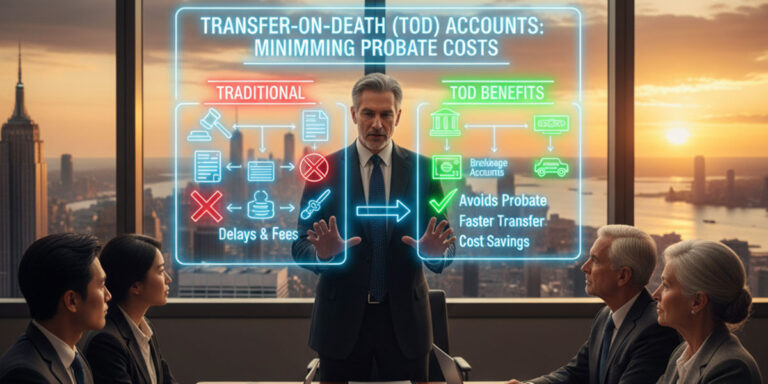
Payable-on-Death (POD) and Transfer-on-Death (TOD) Designations: Many financial institutions allow you to designate beneficiaries for bank accounts (POD) or investment accounts (TOD). Similar to life insurance, these assets pass directly to the named beneficiaries upon your death, avoiding probate.
At Morgan Legal Group, our comprehensive estate planning services help Westchester families understand their unique circumstances and goals. We implement strategies like revocable living trusts and careful asset titling to minimize or avoid probate, ensuring a smoother transition for heirs. Proactive planning can save your loved ones significant time, expense, and emotional distress.
Probate vs. Administration: Understanding the Distinction
While often used interchangeably, “probate” and “administration” refer to distinct processes within New York’s Surrogate’s Court, primarily defined by the presence or absence of a valid will.
Probate: When a Will Exists
Probate is the legal process of validating a deceased person’s will and executing its instructions. When someone dies with a legally valid will, the Surrogate’s Court supervises to:
- Confirm the will’s authenticity and proper execution.
- Verify the testator’s mental capacity and freedom from undue influence.
- Appoint the executor named in the will.
- Oversee the executor’s duties, including asset inventory, debt/tax payment, and distribution according to the will.
The court issues “Letters Testamentary” to the appointed executor, granting them legal authority. The entire process aims to honor the deceased’s documented wishes.
Administration: When There is No Will (Intestacy)
Administration occurs when a person dies without a valid will (intestate). In this scenario, New York’s laws of intestacy dictate how assets are distributed. Key differences include:
- No Will Validation: The court does not validate a will.
- Administrator Appointment: The court appoints an administrator, typically following a statutory order of priority (surviving spouse, children, parents, siblings).
- Distribution by Law: The administrator distributes assets according to intestacy rules, not the deceased’s unwritten personal wishes.
The court issues “Letters of Administration” to the appointed administrator. If a will exists but is deemed invalid, the estate is treated as if there were no will, and the administration process follows.
Small Estates: A Simplified Path
New York offers a simplified “Voluntary Administration” for “small estates” where the total value (excluding certain assets) falls below a specified threshold. This less formal process still requires court involvement to ensure proper asset distribution when no will is present.
For Westchester residents, understanding whether an estate will undergo probate or administration is the first step in planning. Our probate attorneys can determine the correct procedure based on the will’s existence and validity, guiding you through every necessary step.
Elder Law Considerations Intersecting with Probate
As individuals age, elder law issues frequently intersect with the probate process. For Westchester seniors and their families, understanding these connections is vital for comprehensive planning and protection.
-
Powers of Attorney (POA): A durable POA is a crucial elder law tool, allowing a designated agent to manage financial and legal affairs if the principal becomes incapacitated. While a valid POA simplifies an executor’s tasks during probate, it terminates upon the principal’s death. Without a POA, families might face a complex and costly guardianship proceeding if incapacitation occurs before death, highlighting the importance of proactive planning.
-
Guardianship Proceedings: If an individual becomes incapacitated without a POA, a court may initiate a guardianship proceeding to appoint a guardian to make decisions. If this occurs before death, the guardian’s management can impact eventual estate administration. Our guardianship attorneys are skilled in navigating these sensitive proceedings.
-
Medicaid Planning and Estate Recovery: Medicaid planning is central to elder law, especially for long-term care. New York has an estate recovery program, allowing the state to seek reimbursement for Medicaid benefits from a deceased recipient’s estate. This can include assets passing through or outside of probate. Strategic Medicaid planning during life can help protect assets from estate recovery, preserving wealth for heirs while meeting long-term care needs.
-
Preventing Elder Abuse: Sadly, seniors are often targets of elder abuse, including financial exploitation, which can deplete assets or involve fraudulent transactions. Suspected or proven elder abuse can significantly impact probate proceedings, leading to legal challenges or recovery actions. Our elder abuse attorneys work to protect seniors and their assets, pursuing legal recourse when necessary, which directly affects estate settlement.
At Morgan Legal Group, our elder law practice seamlessly integrates with our probate and estate planning services. We assist Westchester seniors and their families in proactive planning for incapacity, managing long-term care needs, and safeguarding their estates from unnecessary depletion or estate recovery.
Immediate Steps After a Loved One’s Passing in Westchester
The period following a loved one’s death in Westchester can be emotionally overwhelming, with urgent tasks demanding attention. Understanding these initial steps can help manage the process more effectively during a difficult time:
-
Obtain a Certified Death Certificate: The Medical Certificate of Death is the first official document needed, typically issued by the attending physician, medical examiner, or hospital. You will require multiple certified copies for various tasks, including initiating probate, notifying financial institutions, and claiming life insurance benefits.
-
Notify Immediate Family and Friends: Inform close family members and friends to facilitate support and collective decision-making regarding funeral arrangements and other immediate needs.
-
Arrange Funeral or Memorial Services: Work with a funeral home to make arrangements for the disposition of the body and any services. Funeral costs are usually paid from the deceased’s estate, though an advance payment may be required.
-
Locate the Will and Key Documents: If a will exists, locate the original document promptly. Gather other essential papers, such as life insurance policies, bank statements, property deeds, investment account information, and pre-paid funeral plans. These are crucial for the executor.
-
Seek Professional Legal Assistance: The legalities of an estate, especially the probate process, can be overwhelming. Consulting an experienced probate attorney in Westchester is highly recommended. An attorney can advise on rights and responsibilities, guide through Surrogate’s Court procedures, and ensure efficient and correct estate settlement.
-
Secure the Deceased’s Property: Ensure the deceased’s home and other properties are secured. This may involve changing locks, maintaining utilities, and protecting valuable personal property. The executor ultimately bears responsibility for these assets.
-
Notify Relevant Institutions: Once certified death certificates are secured and preliminary legal guidance is obtained, notify institutions such as the Social Security Administration, pension providers, banks, credit card companies, and insurance companies. The executor will manage this process.
Taking these steps promptly helps manage the estate efficiently. For Westchester families, a reliable legal partner like Morgan Legal Group provides immense relief during this challenging period. We assist with all aspects of estate settlement, from initial consultation to final distribution. If you need to schedule a consultation, please do not hesitate to reach out.
Frequently Asked Questions About New York Probate
Navigating the probate process in New York often raises numerous questions. Here are clear answers to common inquiries we receive from clients in Westchester and surrounding areas:
Q1: How long does probate typically take in New York?
A1: The duration varies significantly based on estate complexity, potential disputes or will contests, and the Surrogate’s Court’s caseload. Simple estates may resolve in 6-12 months, while complex or litigated estates can take several years.
Q2: What are the costs associated with probate?
A2: Costs include court filing fees, appraisal fees, attorney fees, executor commissions, and potential expenses for selling estate assets. Attorney fees are often based on statutory guidelines or an hourly rate. Our firm maintains transparency regarding all potential costs.
Q3: Can I receive payment as the executor?
A3: Yes, executors are generally entitled to a statutory commission for their services. This commission is typically paid after all debts and administration expenses are settled and requires court approval of the executor’s accounting.
Q4: What happens if the deceased had outstanding debts?
A4: The executor or administrator must identify all creditors and pay legitimate debts from the estate’s assets before distributing any inheritance. If assets are insufficient, New York law dictates the priority for payment.
Q5: Can a will be challenged once probate begins?
A5: Yes, interested parties can challenge a will during probate. Common grounds include claims of undue influence, fraud, lack of testamentary capacity, or improper will execution. A will contest can significantly prolong proceedings.
Q6: What distinguishes an executor from an administrator?
A6: An executor is named in a will by the deceased to manage the estate. An administrator is appointed by the court when there is no will or if the named executor cannot serve. Both roles carry similar responsibilities for estate management and distribution.
Q7: Do all assets necessarily go through probate?
A7: No. Assets held in a trust, jointly owned assets with rights of survivorship, and assets with designated beneficiaries (e.g., life insurance, retirement accounts) generally pass directly to beneficiaries, bypassing probate.
Q8: How can I plan to avoid probate for my own estate?
A8: Strategies include establishing a revocable living trust, holding assets in joint ownership with rights of survivorship, and ensuring proper beneficiary designations on all relevant accounts. Effective estate planning is key.
Q9: What if the deceased owned property in another state?
A9: If the deceased owned real property in another state, “ancillary probate” proceedings may be required in that state, adding complexity and cost to the estate settlement.
Q10: When should I contact a probate attorney?
A10: It is advisable to contact a probate attorney as soon as possible after a death, especially for complex estates, those involving real estate or significant assets, or if disputes among heirs or