For families across New York, the desire to protect loved ones and preserve a lifetime of hard work stands paramount. Yet, navigating the intricate landscape of estate planning can feel overwhelming, especially with ever-evolving laws and financial realities. At Morgan Legal Group, our three decades of dedicated experience reveal a clear truth: a thoughtfully constructed estate plan provides profound peace of mind, while neglecting key steps can lead to unforeseen challenges for your family.
In 2026, the necessity for a robust, up-to-date strategy is more critical than ever. Many New Yorkers mistakenly believe estate planning is a concern only for the wealthy or a task for later life. This misconception often leaves families vulnerable. Regardless of your assets, age, or family structure, a well-executed plan ensures your wishes are honored, your beneficiaries are safeguarded, and unnecessary stress, costs, and delays are avoided during life’s most difficult moments. We specialize in crafting personalized solutions that offer clarity and confidence in this complex legal area.
Defining Your Future: What is New York Estate Planning in 2026?
Estate planning extends far beyond merely drafting a will; it is a comprehensive process designed to secure your future and your family’s financial well-being. This involves making crucial decisions about the management and distribution of your assets after your passing, and equally important, how your personal and financial affairs will be handled if you become incapacitated. In New York, this planning demands an in-depth understanding of state-specific statutes, tax structures, and judicial procedures. With laws continually evolving, expert guidance remains indispensable.
A resilient estate plan typically integrates several interconnected legal instruments. These often include a Last Will and Testament, various types of Wills and Trusts, a Durable Power of Attorney, a Health Care Proxy, and a Living Will. Each document serves a distinct purpose, yet together they form a comprehensive strategy reflecting your values and objectives. Without these essential components, you risk relinquishing critical decisions to the state or inviting family disputes, ultimately compromising the legacy you intend to preserve.
The legal landscape is dynamic; tax codes shift, family structures change, and personal assets grow or diminish. A plan created years ago may no longer align with your current best interests. This reality underscores why continuous engagement with an experienced estate planning attorney is not merely a convenience, but a necessity. At Morgan Legal Group, we partner with you to develop a flexible, living plan, adaptable to life’s inevitable changes, ensuring your strategy remains effective and aligned with your goals well into 2026 and beyond.
Critical Oversight #1: Believing Your Estate Is Too Small to Plan
A widespread misconception we frequently encounter is the belief that estate planning serves only the ultra-wealthy. This myth causes many New Yorkers to postpone or neglect creating an estate plan, convinced they “lack sufficient assets.” In truth, every individual possesses an estate, encompassing everything owned: your home, vehicles, bank accounts, retirement funds, life insurance policies, personal belongings, and even digital assets. If you do not formally designate beneficiaries or provide explicit instructions through a will or trust, New York’s intestacy laws will unilaterally dictate your property’s distribution.
Dying without a will—known as dying intestate—means the State of New York, not you, determines who inherits your assets. This often leads to outcomes that contradict your true wishes. For example, a married individual with children may find their spouse does not inherit everything, potentially causing financial strain or conflict. If no spouse or children survive you, assets might pass to distant relatives you barely know, or even escheat to the state if no legal heirs are identified. This public process can be lengthy and accumulate significant legal and administrative fees, diminishing your legacy’s value.
Furthermore, estate planning extends beyond asset distribution to encompass crucial decisions about your care and the support of your dependents should you become incapacitated. Without a plan, your family could face a costly and emotionally draining Guardianship proceeding through the courts to manage your affairs, eroding your autonomy and imposing financial burdens. A straightforward will, combined with a Power of Attorney and Health Care Proxy, can prevent these complications, offering invaluable clarity and peace of mind.
Critical Oversight #2: Neglecting Guardianship for Minor Children or Dependents
For parents of minor children (under 18 in New York) or individuals caring for adult dependents with special needs, designating a guardian stands as perhaps the most vital aspect of estate planning. Without a legally appointed guardian in your Last Will and Testament, the Surrogates’ Court will undertake the appointment. This process not only adds emotional strain for your children during an already difficult time but also subjects them to a court’s judgment, which may not align with your deeply held values or your intimate knowledge of family dynamics.
The court’s decision relies on a “best interests of the child” standard, examining various factors to determine suitability. While family members are typically prioritized, the chosen relative might not be your preferred choice, or the process could ignite disputes among family members vying for guardianship. Moreover, court proceedings can be protracted and expensive, diverting resources that could otherwise support your children’s care and upbringing. A precisely drafted will explicitly states your choice, streamlining the transition and ensuring your children are raised by individuals you trust implicitly.
Special Considerations for Dependents with Special Needs
If you support a child or loved one with special needs who relies on government benefits like Medicaid or Supplemental Security Income (SSI), a direct inheritance can prove detrimental. Such an inheritance might disqualify them from essential public assistance programs. To avert this, a specialized legal instrument known as a Supplemental Needs Trust (SNT) or Special Needs Trust becomes indispensable. This trust holds assets for the beneficiary’s benefit without jeopardizing their eligibility for critical government aid.
A meticulously structured SNT, expertly drafted by an attorney at Morgan Legal Group, permits funds to be used for expenses not covered by government benefits, such as enhanced quality of life expenditures, therapies, educational programs, or recreational activities. It ensures your loved one’s financial security while preserving their access to vital government services. This intricate legal domain demands precise drafting and strict regulatory adherence, making professional legal counsel absolutely essential to protect your most vulnerable family members.
Critical Oversight #3: Underestimating New York’s Tax Landscape
Estate taxes can significantly reduce the inheritance your loved ones ultimately receive, yet many New Yorkers overlook strategic tax planning within their estate strategy. As of 2026, both New York State and the federal government levy estate taxes, each with distinct thresholds and structures. Grasping these differences is paramount for minimizing your estate’s tax burden. For 2026, the New York State estate tax exemption is projected to be around $7.2 million per individual (adjusted annually for inflation). Estates exceeding this threshold incur NYS estate tax, with rates ranging from 5% to 16%.
New York’s estate tax law features a unique “cliff” effect: if your taxable estate surpasses the exemption amount by more than 5%, the entire estate (not just the excess) becomes subject to tax from the first dollar. This can lead to a disproportionately high tax bill for estates just slightly above the threshold, making precise valuation and proactive planning crucial to avoid this fiscal pitfall. Our firm employs sophisticated strategies to help high-net-worth individuals navigate this complex landscape.
Federally, the estate tax exemption for 2026 is anticipated to be considerably lower than in recent years due to the sunset of provisions from the Tax Cuts and Jobs Act of 2017. While the 2024 federal exemption stood at $13.61 million per individual, it is expected to revert to approximately $7 million per individual (indexed for inflation) in 2026. This significant reduction means a greater number of New York estates will face federal estate tax in addition to state taxes, amplifying the need for expert tax mitigation strategies. For married couples, portability of the federal exemption allows a surviving spouse to utilize the deceased spouse’s unused exemption, but this necessitates a timely filed federal estate tax return (Form 706).
Advanced Tax Minimization Strategies in New York
To mitigate both NYS and federal estate taxes, we often recommend various advanced planning techniques:
- Irrevocable Life Insurance Trusts (ILITs): An ILIT holds life insurance policies outside your taxable estate, ensuring death benefits pass directly to beneficiaries tax-free.
- Strategic Gifting: Utilizing annual exclusion gifts (likely higher than 2024’s $18,000 per donee in 2026) and lifetime exemption gifts can reduce your taxable estate’s size.
- Charitable Trusts: Charitable Remainder Trusts (CRTs) and Charitable Lead Trusts (CLTs) can provide income streams to beneficiaries or charities while removing assets from your estate and potentially generating income tax deductions.
- Grantor Retained Annuity Trusts (GRATs): These trusts facilitate the transfer of appreciating assets out of your estate, allowing you to retain an income stream for a period, with any appreciation passing tax-free to beneficiaries.
- Marital Deduction Planning: For married couples, planning can involve leveraging the unlimited marital deduction to defer estate taxes until the surviving spouse’s death, often through A-B trusts or credit shelter trusts.
Implementing these strategies demands meticulous planning and a profound understanding of tax law. The attorneys at Morgan Legal Group excel at designing customized plans that achieve your wealth transfer goals while minimizing the impact of estate taxes, ensuring more of your legacy reaches your intended heirs. For further details on New York’s specific tax regulations, you can visit the New York State Department of Taxation and Finance.
Critical Oversight #4: Ignoring the Probate Process
For many New Yorkers, the mere mention of Probate & Administration evokes images of lengthy, expensive, and emotionally exhausting court proceedings. This perception often aligns with reality. New York’s probate process, which legally validates a will and administers an estate, can indeed be complex, costly, and time-consuming. It involves court hearings, filing numerous documents with the Surrogates’ Court (governed by the SCPA), meticulous accounting for all assets and debts, and public disclosure of your financial affairs. Your beneficiaries cannot access their inheritance until probate concludes, a process that can span many months, or even years, depending on the estate’s complexity and potential disputes.
The expenses linked to probate can significantly diminish your estate’s value. These costs include court filing fees, attorney’s fees, executor commissions, appraisal fees, and potential bond premiums. While a will is essential for expressing your wishes, it does not bypass probate; rather, it directs how your assets will be distributed through probate. Understanding these implications is crucial for proactive planning, particularly for those who wish to spare their families undue burden during a time of grief.
Strategies for Minimizing or Avoiding Probate in New York
Fortunately, several effective strategies exist to significantly minimize or entirely avoid the probate process in New York:
- Revocable Living Trusts: This is arguably the most potent tool for probate avoidance. Assets transferred into a living trust during your lifetime are managed by a trustee (often you, as the grantor) for your benefit. Upon your death, the trust assets can be distributed directly to your named beneficiaries, bypassing court involvement. This method ensures privacy, reduces delays, and typically lowers overall administrative costs compared to probate.
- Joint Ownership with Rights of Survivorship: Assets held in joint tenancy with rights of survivorship (e.g., a joint bank account or real estate) automatically pass to the surviving owner upon the other’s death, bypassing probate. However, this strategy requires careful consideration, as it can expose assets to the joint owner’s creditors and may carry unintended tax consequences.
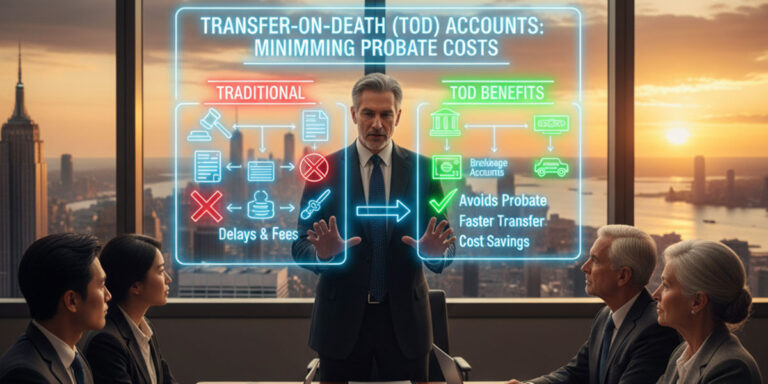
- Beneficiary Designations: Life insurance policies, retirement accounts (401(k)s, IRAs), and certain bank or brokerage accounts (Payable-on-Death, POD, or Transfer-on-Death, TOD) allow you to name specific beneficiaries. These assets transfer directly to the designated individuals upon your death, outside of probate. Regularly reviewing and updating these designations is critical, as they often override instructions within your will.
- Small Estate Administration: For estates with very limited assets (as defined by New York’s Small Estate Act, SCPA Article 13), a simplified administration process may be available, offering a quicker and less expensive alternative to full probate. However, most estates exceed these limits, requiring full probate or administration.
Choosing the appropriate probate avoidance strategy depends on your specific assets, family dynamics, and overall goals. Our attorneys at Morgan Legal Group possess extensive experience in designing and implementing plans that effectively navigate the New York Probate & Administration system, saving your family time, money, and emotional strain.
Critical Oversight #5: Allowing Your Estate Plan to Become Outdated
An estate plan is not a static document; it functions as a living framework that must adapt to the inevitable shifts in your life, your family’s circumstances, and the legal landscape. One of the most prevalent and damaging mistakes we observe is the failure to review and update estate planning documents after their initial creation. Life is dynamic, and what served as an appropriate plan years ago may now be entirely obsolete or even counterproductive to your current wishes and goals. Neglecting to update your plan can lead to unintended beneficiaries, significant legal disputes, increased taxes, and the invalidation of crucial provisions.
Consider the numerous life events that necessitate a thorough review:
- Marriages, Divorces, and Remarriages: A new spouse typically acquires inheritance rights, and an ex-spouse often needs removal as a beneficiary or agent.
- Births, Adoptions, and Deaths: The arrival of new family members or the passing of a named beneficiary, executor, or trustee demands updating your documents to reflect these changes.
- Significant Changes in Assets or Wealth: Acquiring new properties, launching a business, receiving an inheritance, or experiencing substantial changes in financial assets warrants a re-evaluation of your distribution strategy and tax planning.
- Changes in Residence: Moving to a new state requires your plan to be reviewed for compliance with the laws of your new domicile, as estate laws vary considerably by state.
- Changes in the Law: Tax statutes, probate rules, and NYC Elder Law regulations are in constant flux. A plan drafted under older laws might become ineffective or suboptimal.
- Changes in Relationships: A strained relationship with a named beneficiary or agent may necessitate their removal.
If your estate plan names a deceased person as a beneficiary or an executor, those provisions become invalid, potentially triggering intestacy rules for that portion of your estate or requiring the court to appoint an administrator. This undermines your control and can cause costly delays. Similarly, if you have named a minor child without an accompanying trust, their inheritance may become tied up in court-supervised guardianship until they reach adulthood, potentially jeopardizing their financial future.
The Morgan Legal Group Approach to Plan Maintenance
At Morgan Legal Group, we emphasize the critical importance of regular plan maintenance. We recommend reviewing your entire estate plan every three to five years, or immediately following any significant life event. This proactive approach ensures your documents remain aligned with your current intentions and the prevailing legal environment. Our attorneys can assist with all necessary amendments, such as codicils to wills or trust amendments, ensuring updates are executed correctly and remain legally binding.
Critical Oversight #6: Failing to Plan for Incapacity
While uncomfortable to consider, the possibility of becoming incapacitated due to illness or injury is a reality everyone faces. One of the most significant oversights in estate planning is the failure to prepare for this contingency. Without proper incapacity documents, your loved ones could confront immense challenges managing your financial affairs and making critical healthcare decisions on your behalf. This lack of planning can trigger family conflict, freeze assets, and necessitate a costly and public Guardianship proceeding under Article 81 of the Mental Hygiene Law, where a court appoints someone to manage your personal and financial life, potentially against your wishes.
Incapacity planning empowers you to retain control over who makes decisions for you and how those decisions are made, even when you cannot voice them yourself. It designates trusted individuals to act on your behalf, eliminating uncertainty and potential legal battles among family members. This proactive step forms a cornerstone of comprehensive estate planning, providing a clear roadmap for your care and financial management during vulnerable times.
Essential Incapacity Planning Documents in New York
A robust incapacity plan typically includes:
- Durable Power of Attorney (POA): This vital legal document allows you to appoint an agent to manage your financial and legal affairs if you become unable to do so. A “durable” POA remains effective even if you become incapacitated. It is crucial to appoint someone you trust implicitly, as they will wield broad authority over your bank accounts, investments, real estate, and other assets. The New York Statutory Durable Power of Attorney form provides a standardized framework, but customization is often necessary to grant specific powers.
- Health Care Proxy: This document enables you to designate a trusted individual (your health care agent) to make medical decisions for you if you are unable to communicate your wishes. Your agent can consult with doctors, access your medical records, and consent to or refuse medical treatment.
- Living Will: While the Health Care Proxy designates who makes decisions, a Living Will specifies what those decisions should be regarding end-of-life care. It allows you to express your preferences concerning life-sustaining treatments (e.g., artificial respiration, feeding tubes) if you are in a terminal condition or permanently unconscious.
- HIPAA Authorization: This document grants specific individuals (e.g., your health care agent or family members) access to your protected health information, which is otherwise restricted by federal law. Without it, even a spouse might be denied access to critical medical updates.
Without these documents, your family may be forced to initiate an Article 81 Guardianship proceeding, a public and often expensive court process that strips you of autonomy. Our NYC Elder Law attorneys are experts in drafting these critical documents, ensuring they are legally sound, clearly reflect your wishes, and provide the protection your family needs during challenging times. We empower you to maintain control over your future, no matter what it holds.
Critical Oversight #7: The Perils of DIY Estate Planning
Perhaps the most significant and overarching mistake New Yorkers make in estate planning is attempting to navigate this complex legal terrain without the guidance of an experienced attorney. In the digital age, numerous online templates and do-it-yourself kits promise quick and inexpensive solutions. While these resources may seem appealing, they often carry hidden costs and substantial risks that can far outweigh any perceived savings. Estate planning is not a one-size-fits-all endeavor; it demands a deep understanding of evolving New York State laws, tax codes, and your unique family and financial situation.
Online forms and generic templates rarely account for the specific nuances of New York law, which can differ significantly from federal regulations or laws in other states. Even minor errors in drafting, improper execution (witness requirements, notarization), or a lack of understanding of legal terminology can render a document invalid, leading to costly litigation, family disputes, and outcomes completely contrary to your intentions. For instance, a poorly drafted will might fail to effectively distribute assets, or a trust might not achieve its intended tax or probate avoidance benefits, leaving your family with unforeseen headaches and expenses.
An experienced estate planning attorney provides invaluable expertise that extends far beyond simply filling out forms:
- Customized Solutions: We invest time to understand your individual goals, family dynamics, assets, and liabilities, crafting a bespoke plan that truly reflects your wishes.
- Legal Compliance: We ensure all documents comply with current New York State laws, preventing future challenges to their validity.
- Tax Efficiency: We strategically advise on minimizing estate, gift, and income taxes, leveraging advanced planning techniques where appropriate.
- Probate Avoidance: We implement strategies to help your family navigate the Probate & Administration process efficiently or avoid it altogether.
- Incapacity Planning: We draft robust documents like the Durable Power of Attorney and Health Care Proxy to protect you during times of vulnerability.
- Guardianship Guidance: For families with minor children or dependents with special needs, we ensure proper Guardianship designations are in place.
- Ongoing Support: We offer continuous partnership, helping you review and update your plan as life unfolds and laws change.
The profound peace of mind that stems from knowing your estate plan is legally sound, comprehensive, and tailored to your specific needs is priceless. Investing in professional legal counsel from Morgan Legal Group is an investment in your family’s future security and your lasting legacy.
Building a Resilient Legacy: Core Elements of Your New York Estate Plan
A truly comprehensive estate plan transcends merely avoiding pitfalls; it constructs a sturdy framework designed to protect your interests and provide for your loved ones. At Morgan Legal Group, we empower every client with a full understanding of the tools at their disposal. Here are the core components we typically integrate into a comprehensive New York estate plan:
The Last Will and Testament
A Will serves as the foundational document in most estate plans. It enables you to designate beneficiaries for your assets, name an executor to manage your estate, and, critically, appoint guardians for any minor children. While a will proceeds through Probate & Administration, it remains the sole legal document dictating your wishes regarding guardianship. Without a will, New York’s intestacy laws will determine your asset distribution, which may not align with your intentions. We meticulously draft wills that are clear, legally enforceable, and fully compliant with New York’s strict execution requirements.
Trusts: Versatile Tools for Asset Management and Protection
Trusts are remarkably flexible instruments capable of achieving a multitude of goals, from probate avoidance and tax minimization to asset protection and special needs planning. We design and implement various types of trusts, each serving a unique purpose:
- Revocable Living Trusts: These trusts allow you to maintain control over your assets during your lifetime, avoid probate upon your death, and manage your affairs if you become incapacitated. They are easily amendable or revocable.
- Irrevocable Trusts: Once established, these trusts generally cannot be altered or revoked. They are powerful tools for estate tax planning, asset protection (e.g., from creditors or long-term care costs), and charitable giving.
- Special Needs Trusts (SNTs): Essential for protecting the eligibility of disabled beneficiaries for government assistance programs while providing for their supplemental needs.
- Testamentary Trusts: Created within your will, these trusts become effective upon your death and are often utilized to manage inheritances for minors or young adults until they reach a specified age.
The optimal choice of trust depends entirely on your specific objectives, and our firm provides expert guidance in selecting and drafting the most appropriate trust structures for your