
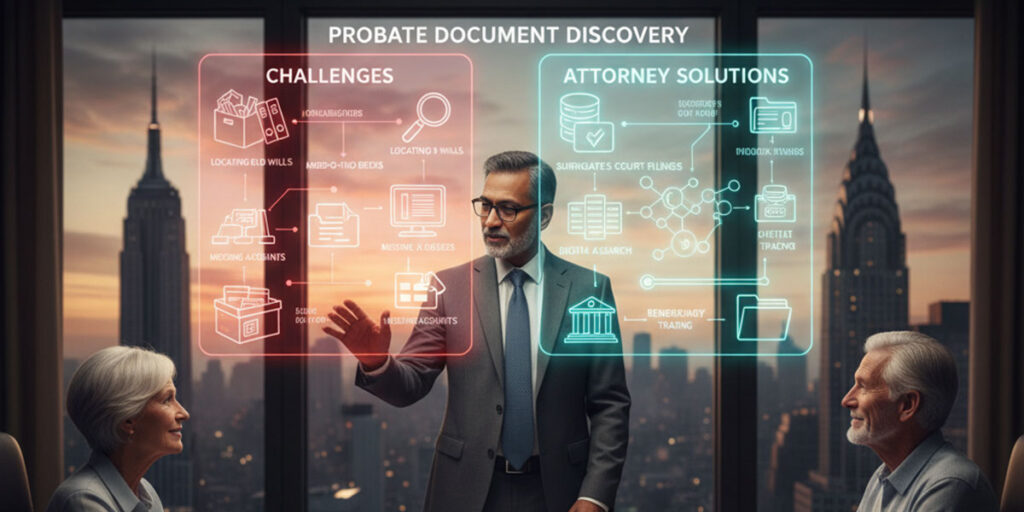
The days following the loss of a loved one are filled with grief, confusion, and overwhelming administrative tasks. Among the most stressful challenges is the “treasure hunt.” You know your parent or spouse had assets. You know they likely had a Will. But as you sift through their desk drawers and file cabinets, you find nothing but old utility bills and expired warranties.
Without the proper legal documents, the probate process in New York comes to a grinding halt. You cannot access bank accounts. You cannot sell real estate. You cannot pay final expenses. The estate is frozen.
I am Russel Morgan, founder and lead attorney at Morgan Legal Group. Over the past 30 years, our firm has successfully handled over 1,000 complex estate cases in New York State. We have earned over 900+ positive online reviews because we do not just file paperwork; we solve severe legal crises. In many of these cases, our first job is acting as a legal detective.
In 2026, finding probate documents requires more than just looking in a closet. It requires court orders, subpoenas, and a deep understanding of the New York Surrogate’s Court system. This cornerstone guide will explain exactly how a seasoned estate planning attorney locates missing Wills, uncovers hidden financial assets, and forces institutions to hand over the documents you need to secure your family’s legacy.
1. The Missing Will: The Ultimate Legal Crisis
The most critical document in any estate is the Original Last Will and Testament. Notice the word “Original.” The New York Surrogate’s Court is notoriously strict regarding this requirement. A photocopy or a scanned PDF on a computer is generally insufficient.
The “Presumption of Revocation”
In New York, if it is known that the deceased possessed their original Will, but it cannot be found after their death, the law assumes a harsh reality. The court presumes the deceased intentionally destroyed the Will to revoke it. Overcoming this “Presumption of Revocation” is a monumental legal hurdle.
How We Find the Will
When clients come to Morgan Legal Group with a missing Will, we deploy several aggressive strategies.
- The Drafting Attorney Search: If you only have a photocopy, we identify the law firm printed on the cover. We formally contact that attorney. Often, the original Will is sitting in their fireproof vault.
- Surrogate’s Court Vaults: Some proactive individuals file their original Wills and Trusts with the Surrogate’s Court for safekeeping before they die. We conduct comprehensive searches of the court records in the decedent’s county of residence.
- The Safe Deposit Box Petition: This is the most common hiding place, but it presents a legal “Catch-22,” which we will explain in the next section.
Probating a Copy of a Will
If the original is truly lost, an experienced attorney can sometimes probate a photocopy. This requires a complex evidentiary hearing. We must prove to the judge that the Will was not intentionally revoked, that it was validly executed, and we must provide affidavits from the original witnesses. This is high-stakes litigation where our firm’s extensive experience is critical.
2. The Safe Deposit Box “Catch-22”
Imagine this scenario. Meet Sarah from Brooklyn. Her father passes away. She finds a key to a Chase Bank safe deposit box. She goes to the bank, certain the Will is inside. The bank manager asks for her “Letters Testamentary” (the court document proving she is the Executor). Sarah explains she needs the Will to get the Letters Testamentary. The bank refuses entry.
This is the classic New York probate Catch-22.
The SCPA 2003 Proceeding
You cannot bully a bank manager into opening a safe deposit box. You need a court order. As your attorneys, we file a specific proceeding under the Surrogate’s Court Procedure Act (SCPA) Section 2003.
We petition the court for an “Order to Search.” The judge signs an order directing the bank to open the box in the presence of a bank officer. Crucially, you are not allowed to take anything of monetary value out of the box during this search. You cannot take jewelry, cash, or stock certificates. You are only permitted to remove:
- The original Last Will and Testament (which the bank must mail directly to the court).
- A deed to a burial plot.
- Life insurance policies naming a specific beneficiary.
Navigating this petition quickly is essential. A delay here stalls the entire probate process.
3. Locating Hidden Financial Assets
Once the Will is found and the Executor is appointed, the next hurdle is the asset inventory. In 2026, many people have opted out of paper statements entirely. If the deceased did not leave a spreadsheet of their accounts, finding their money is exceptionally difficult.
The “Follow the Money” Strategy
As experienced probate attorneys, we act as forensic accountants. We do not guess; we follow the paper trail.
- Income Tax Returns (Form 1040): We request the last three years of federal and state tax returns. Schedule B will list every bank and brokerage firm that paid the deceased interest or dividends. This instantly gives us a map of their financial institutions.
- IRS Form 4506-T: If we cannot find the tax returns, we file Form 4506-T with the IRS to obtain official transcripts of all 1099 and W-2 forms issued to the decedent.
- Mail Forwarding: We advise Executors to forward the decedent’s mail to our office or their home. We wait for quarterly statements, annual reports, or proxy voting materials from brokerage houses to arrive.
The New York State Comptroller Search
Banks are required to turn over dormant accounts to the state. We conduct exhaustive searches through the New York State Office of Unclaimed Funds. We have recovered hundreds of thousands of dollars in “lost” money for our clients simply by knowing how to navigate this government database.
4. The Digital Frontier: Finding Online Assets
In 2026, a massive portion of wealth is invisible. It exists in cryptocurrency wallets, PayPal accounts, and purely digital banking platforms. How do you find a document or an asset that only exists behind a password?
The Federal Privacy Wall
You cannot simply guess your parent’s password and log in. The federal Computer Fraud and Abuse Act (CFAA) makes unauthorized access a crime. Furthermore, tech companies like Google, Apple, and Facebook have strict Terms of Service that terminate accounts upon death.
New York EPTL Article 13-A
To break through this wall, we utilize New York Estates, Powers and Trusts Law Article 13-A. This powerful statute grants a legally appointed fiduciary the right to access digital assets.
If the tech company refuses to cooperate, Morgan Legal Group will draft subpoenas and court orders compelling them to turn over email records, cloud storage documents, and financial transaction histories. Often, a single email from a crypto exchange or an online bank is the key that unlocks a massive, previously unknown asset.
5. Uncovering Real Estate Deeds and Mortgages
Real estate is typically the largest asset in a New York estate. Sometimes, families are aware of a primary residence but are unaware of rental properties, vacant land, or timeshares.
The ACRIS Database and County Clerks
If the property is located in the five boroughs of New York City, we conduct exhaustive searches through the Automated City Register Information System (ACRIS). This database contains every recorded deed, mortgage, and lien.
We analyze these documents to determine exactly how the property was titled. Was it held as Joint Tenants? Was it placed in a Living Trust? Are there outstanding mortgages or mechanics liens? If the property is outside NYC, we interface directly with the respective County Clerk’s offices across New York State to pull the official property records.
6. Finding Missing Heirs (The Kinship Proceeding)
Sometimes, the missing “document” is actually a missing person. When you file for probate in New York, you must notify all “Distributees” (the legal next of kin). If the deceased had a child from a previous marriage who hasn’t been seen in 40 years, the court will not let you proceed until you find them.
The Due Diligence Requirement
The Surrogate’s Court demands proof of “due diligence.” You cannot simply tell the judge, “We don’t know where he is.”
Our firm employs professional genealogists and private investigators. We search birth records, census data, immigration manifests, and international databases. If the heir truly cannot be found, we compile this exhaustive search into a formal affidavit. We then petition the court to allow “Publication”—notifying the missing heir by printing a legal notice in a designated newspaper. This highly technical process is virtually impossible for a layperson to execute correctly without a skilled attorney.
7. The Danger of DIY Estate Administration
When a family attempts to handle an estate without professional help, the results are often disastrous. Without legal authority, banks will ignore your phone calls. Without subpoena power, tech companies will delete vital emails. Without knowing where to look, hundreds of thousands of dollars in assets can be abandoned to the state.
The Fiduciary Risk
If you are the Executor, you have a strict fiduciary duty to marshal (gather) all assets. If you fail to find a brokerage account because you didn’t know how to request an IRS tax transcript, the other beneficiaries can sue you personally for negligence. Hiring Morgan Legal Group transfers the burden of this complex investigation to seasoned professionals.
8. Preventative Care: Organize Before Crisis Strikes
The best way to “find” probate documents is to never lose them in the first place. This is the core of our estate planning practice.
When we draft a comprehensive estate plan, which includes Wills, Trusts, Powers of Attorney, and Health Care Proxies, we do not just hand our clients a stack of paper. We help them create a “Digital Vault.”
We instruct our clients to compile a definitive list of all bank accounts, life insurance policies, real estate deeds, and digital passwords. We ensure that Successor Trustees know exactly where the original documents are stored. By doing the hard work now, we guarantee that your family will never have to endure a traumatic treasure hunt while they are grieving.
Conclusion: Turn Chaos into Clarity
Finding missing probate documents in New York is a high-stakes legal investigation. It requires court orders to open safe deposit boxes, subpoenas to pierce digital privacy walls, and forensic accounting to track hidden money. You cannot rely on hope; you must rely on legal leverage.
If you are staring at a stack of unorganized papers, or if a bank has just frozen your deceased parent’s account, do not panic. We have walked this path over a thousand times.
Let us find what you have lost. Schedule a consultation with Morgan Legal Group today. We will take over the investigation, secure the necessary court orders, and ensure your family’s inheritance is fully recovered and protected. For immediate assistance, please contact us directly.
For more information on the laws governing safe deposit box searches, please review the text of New York Surrogate’s Court Procedure Act (SCPA) Section 2003.