The days following the death of a loved one are emotionally exhausting. The last thing you want to face is a legal brick wall. Yet, for many families in New York City, the probate process halts before it even begins. You know your parent or spouse executed a Will. You might even have a fuzzy photocopy. However, the original document is locked away, hidden, or being intentionally withheld.
In New York State, you cannot simply ask a bank manager to hand over a deceased person’s documents. You cannot force a stubborn sibling to open a home safe by yourself. Accessing the Will requires formal, aggressive legal leverage.
I am Russel Morgan, the founder and lead attorney at Morgan Legal Group. For over three decades, our firm has successfully navigated the complexities of the New York Surrogate’s Court. We have handled over 1,000 complex estate planning and administration cases. Our 900+ positive online reviews stand as proof of our commitment to breaking down legal barriers for our clients.
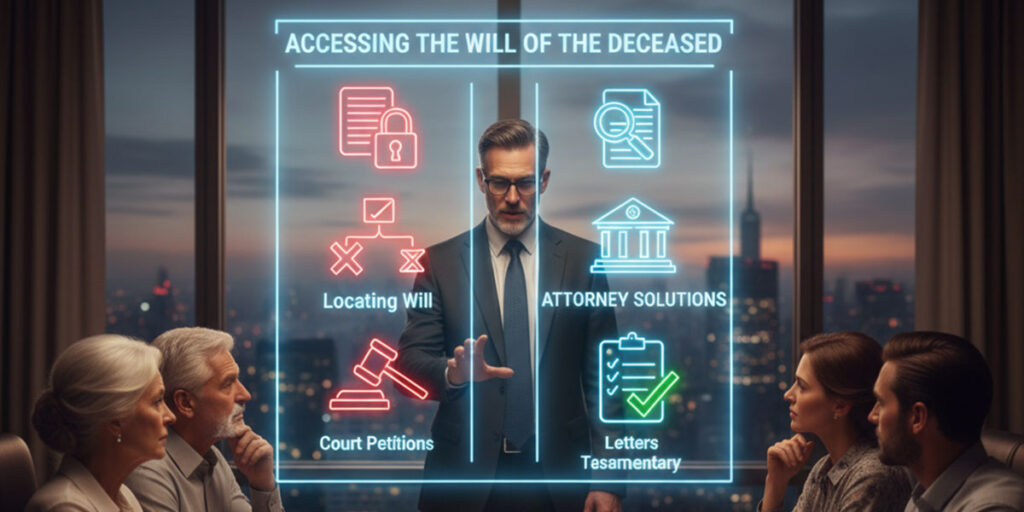
In 2026, privacy laws and banking regulations are stricter than ever. This cornerstone guide will explain the exact legal mechanisms an expert probate attorney uses to help you access the Will of the deceased. We will cover safe deposit box petitions, court orders to compel uncooperative relatives, and the vital importance of the “Original Will” rule.
The New York “Original Will” Rule: Why Copies Fail
Before we discuss how to access the Will, you must understand why finding the original is paramount.
The New York Surrogate’s Court operates under a strict presumption. If the deceased was known to possess their original Last Will and Testament, and that original cannot be found after their death, the law presumes they intentionally destroyed it to revoke it. This is known as the “Presumption of Revocation.”
While an experienced estate planning attorney can sometimes probate a photocopy, it requires a highly complex evidentiary hearing. Therefore, gaining physical access to the original, ink-signed document is your absolute first priority.
Scenario 1: The Safe Deposit Box Catch-22
The most common hiding place for a Will is a bank safe deposit box. This presents a frustrating paradox for families across New York.
Meet David from Manhattan. His mother passed away. He finds the key to her Chase Bank safe deposit box. David goes to the branch, expecting to retrieve the Will so he can be appointed Executor. The bank manager demands “Letters Testamentary” (the court document proving he is the Executor) before allowing entry. David cannot get the Letters Testamentary without the Will, which is locked in the box.
The Solution: SCPA Section 2003
You cannot argue your way past a bank’s legal department. You need a court order. At Morgan Legal Group, we immediately file a petition under Surrogate’s Court Procedure Act (SCPA) Section 2003.
This legal mechanism allows us to petition the court for an “Order to Search.” The Surrogate’s Court judge issues a mandate directing the bank to open the box in the presence of a bank officer. It is important to note that this order is extremely narrow in scope.
- You cannot remove jewelry, cash, or stock certificates.
- You can only remove the original Will, a deed to a burial plot, and life insurance policies.
- The bank officer will physically mail the original Will directly to the Surrogate’s Court.
By utilizing SCPA 2003, we smash through the bank’s privacy wall and legally retrieve the foundational document of your family’s estate plan.
Scenario 2: The Uncooperative Relative
Sometimes, the Will is not locked in a bank vault. It is locked in the home of an uncooperative family member. Money often brings out the worst in people, and a sibling living in the deceased parent’s home may refuse to turn over the Will if they suspect it disinherits them.
The Solution: SCPA Section 1401 (Compelling Production)
If someone is intentionally withholding a Will in New York, they are obstructing justice. An individual cannot hold an estate hostage. Our attorneys utilize SCPA Section 1401 to force their hand.
We file a proceeding to “Compel Production of a Will.” The judge will issue an order directing the uncooperative individual to appear in court. They must either produce the Will or testify under oath as to its whereabouts. If they lie under oath, they face severe penalties, including potential elder abuse or fraud charges.
This aggressive legal action demonstrates to uncooperative family members that you have powerful representation. Often, the mere filing of the SCPA 1401 petition is enough to make the hidden document miraculously appear.
Scenario 3: The Drafting Attorney’s Vault
Many diligent New Yorkers leave their original Wills and Trusts in the fireproof vaults of the law firm that drafted them. If you only have a photocopy, or if you simply know the name of your parent’s lawyer, this is your best starting point.
The Attorney-Client Privilege Hurdle
You might call the law firm and ask for the Will, only to be told they cannot confirm or deny its existence due to attorney-client privilege. Death does not immediately erase this privilege.
How We Secure the Release
As your legal counsel, we know how to formally request these documents. We provide the drafting attorney with an original certified death certificate and proper legal authorization. We arrange for the secure transfer of the original Will from their vault directly to the Surrogate’s Court or to our secure offices at Morgan Legal Group.
Furthermore, if the original drafting attorney has retired or passed away, we utilize our extensive network and New York State Bar Association resources to track down the attorney who absorbed their practice and their physical files.
Scenario 4: The Surrogate’s Court Safekeeping Vault
In some rare instances, individuals choose to file their original Will with the local Surrogate’s Court for safekeeping while they are still alive. This ensures the document is protected from fire, theft, or tampering.
If we suspect this is the case, our probate team will conduct a thorough search of the court’s indexes in the county where the deceased resided. Once we present the death certificate, the court will move the Will from the safekeeping vault into the active probate queue.
What If The Will Was Executed in a Hospital or Nursing Home?
In emergency situations, a Will may have been drafted and signed shortly before death in a medical facility. These situations are ripe for missing documents and subsequent litigation.
Securing Medical and Legal Records
If the Will was executed in a nursing home, the social worker or facility administrator may have placed the original document in the patient’s administrative file. We immediately dispatch formal legal demands to the facility to secure the entire file. If we suspect the deceased lacked mental capacity when signing, we will also subpoena the medical records to investigate potential undue influence or elder abuse.
The Dangers of DIY Estate Administration
Attempting to locate and secure a Will without professional legal assistance is a recipe for prolonged grief and financial loss. Financial institutions are trained to deny access to unauthorized individuals. Uncooperative relatives will ignore your text messages. Without the threat of a court subpoena, you have no leverage.
When you hire Morgan Legal Group, you are not just hiring paper-pushers. You are hiring aggressive legal advocates. We utilize the full power of the New York State legal system to locate, secure, and validate your family’s essential estate planning documents.
Beyond the Will: Accessing Other Essential Documents
Finding the Will is only the first step. To successfully navigate the probate process, you will also need access to other critical documents. A comprehensive estate plan is an ecosystem, and missing pieces cause delays.
Finding the Trust Documents
If your parent established a Revocable Living Trust to avoid probate, finding that original document is equally crucial. Trust documents are private contracts and are not filed with the court. We utilize our investigative strategies to locate the original Trust instrument, ensuring the named Successor Trustee can immediately assume control without court interference.
Uncovering Financial Statements and Deeds
To prepare the probate petition, we must estimate the value of the estate. If the deceased was secretive about their finances, we must act as forensic accountants. We use our legal authority to compel banks, brokerage houses, and life insurance companies to release account balances. We conduct title searches across New York State to locate all real estate deeds.
Incapacity Planning: Preventing the Crisis
The best way to “access” a Will is to ensure it is never hidden in the first place. At Morgan Legal Group, we believe in proactive estate planning. We help our clients build secure, organized systems.
When we draft your Power of Attorney, Health Care Proxy, and Last Will and Testament, we provide explicit instructions to your named fiduciaries. We ensure your Executor knows exactly where the original documents are stored. By maintaining a transparent, well-organized estate plan, you spare your family the agony of a legal treasure hunt during their time of mourning.
Why Experience Matters in the Surrogate’s Court
The New York Surrogate’s Court is governed by highly specific, complex procedural rules. A single incorrectly formatted petition can result in months of rejection and delay. You need a law firm that understands both the administrative minutiae and the aggressive tactics required for litigation.
Our extensive experience with over 1,000 successful cases means we know exactly where the legal landmines are hidden. If a sibling attempts to contest the Will or challenges your appointment as Executor, we have the family law and probate litigation experience to protect your rights aggressively in court.
Furthermore, if the estate involves complex elder law issues, such as Medicaid liens or guardianship proceedings prior to death, our holistic approach ensures all overlapping legal issues are resolved efficiently.
Conclusion: Turn Frustration into Legal Action
You cannot settle an estate if you cannot find the instructions. If you are staring at a locked safe deposit box, or if a relative is refusing to hand over your parent’s Last Will and Testament, do not accept defeat.
You have powerful legal rights under New York law. It requires an expert attorney to activate them. By partnering with an experienced legal team, you can compel the production of the Will, secure your family’s assets, and ensure a smooth, peaceful transition of wealth.
Do not let red tape block your legacy. Schedule a consultation with Morgan Legal Group today. We will take over the legal burden so you can focus on your family. If you have an immediate emergency regarding a hidden Will, please contact us directly. We are ready to fight for your rightful access.
For more detailed information regarding the statutory rules for compelling the production of a Will, please review the text of New York Surrogate’s Court Procedure Act (SCPA) Section 1401.