
Probating a Will in New York vs. New Jersey (2026 Guide): Navigating Cross-Border Estates & Ancillary Proceedings
The Hudson River separates New York and New Jersey, but for thousands of families, life—and death—spans both banks. You might live in a condo in Manhattan but own a shore house in Deal, NJ. Or perhaps you retired to Bergen County but kept your investment property in Brooklyn. While living across two states is common, dying with assets in both creates a legal labyrinth known as Cross-Border Probate.
As an estate planning and probate attorney with over 30 years of experience, I, Russel Morgan, have helped over 1,000 families navigate the distinct and often conflicting court systems of New York and New Jersey. In 2026, with court backlogs persisting and tax laws diverging, understanding where and how to file is critical.
If you have been named Executor of an estate that touches both NY and NJ, you likely have questions. “Do I need two lawyers?” “Which state do I file in first?” “Why is New York so much more expensive?” This comprehensive cornerstone guide will answer those questions, comparing the two systems and explaining how Morgan Legal Group can serve as your single bridge over troubled legal waters.
The Fundamental Difference: “Solemn Form” vs. “Common Form”
Before we discuss logistics, you must understand that New York and New Jersey approach probate fundamentally differently. This difference dictates the speed and cost of your case in 2026.
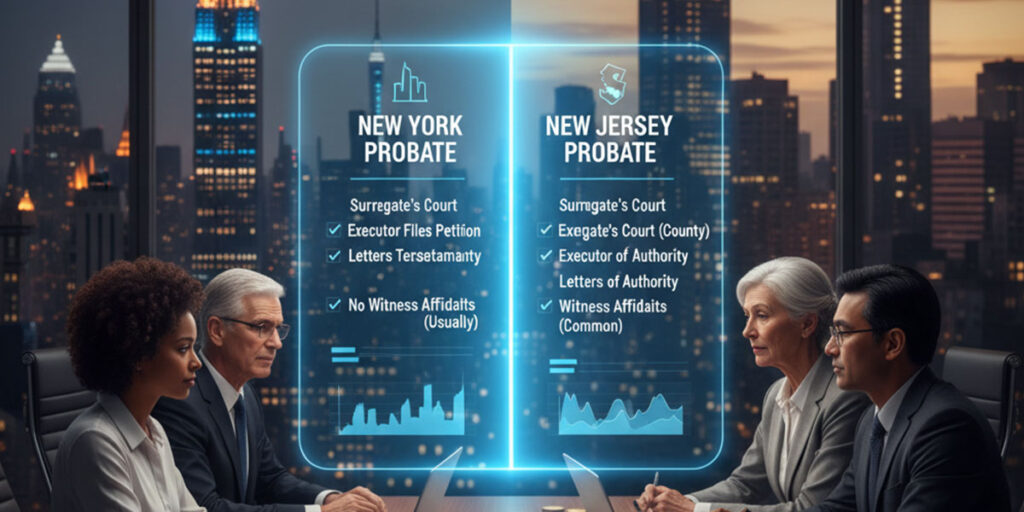
New York: The “Strict” State (Solemn Form)
New York follows “Solemn Form” probate.
- The Process: The Executor cannot do anything until the court validates the Will.
- The Notification: You must track down every legal heir (next of kin) and get them to sign a waiver consenting to the Will. If one cousin refuses to sign or cannot be found, the entire process stops.
- The Result: It is slower, more expensive, and more prone to litigation.
New Jersey: The “Simple” State (Common Form)
New Jersey is often called a “probate-friendly” state.
- The Process: You can often walk into the County Surrogate’s office with the Will, the death certificate, and a check, and walk out with “Letters Testamentary” in less than an hour (after a 10-day waiting period).
- The Notification: You generally notify heirs *after* the Will is admitted to probate.
- The Result: It is faster and involves less initial court supervision.
Scenario 1: Primary Probate in New York
If the decedent’s “domicile” (primary residence) was in New York (e.g., NYC, Long Island, Westchester), you must file for Primary Probate in the NY Surrogate’s Court.
The 2026 Hurdles in NY
In 2026, the New York courts are still battling post-pandemic backlogs.
- Filing Fees: NY fees are tiered based on the estate’s value. For an estate over $500,000, the filing fee alone is $1,250.
- The “Citation” Delay: If you cannot find an heir, you must publish a notice in the newspaper, which adds months to the timeline.
- Executor Commissions: NY law sets a mandatory fee for Executors (5% on the first $100k, 4% on the next $200k, etc.). This significantly reduces the inheritance for beneficiaries if the Executor takes the fee.
Morgan Legal Group Advantage: We use the NYSCEF (electronic filing) system to expedite NY filings, often cutting wait times by 30-50% compared to paper filings.
Scenario 2: Primary Probate in New Jersey
If the decedent lived in New Jersey (e.g., Jersey City, Alpine, Short Hills), you file with the County Surrogate in their home county.
The 2026 Nuances in NJ
While simpler, NJ has its own traps.
- The “Original Will” Rule: NJ is very strict about the original document. If the staples are removed or there are handwritten notes, the Surrogate may reject it, forcing you into a more complex Superior Court hearing.
- The Estate Tax vs. Inheritance Tax: NJ abolished its *Estate Tax*, but it still has an Inheritance Tax. This tax applies if assets are left to anyone other than a spouse, parent, or child (e.g., siblings, nieces, or friends are taxed at 11-16%). NY does not have this specific tax on siblings.
- The Surety Bond: Unlike NY, NJ often waives the requirement for a bond more easily, provided the Will says so.
The Nightmare: “Ancillary Probate” (When You Own Both)
This is the most common reason clients seek our firm.
The Rule: Real Estate is governed by the laws of the state where it sits. A New York court cannot transfer a New Jersey deed, and vice versa.
Example A: The Snowbird
Your father lived in Manhattan (primary) but owned a beach house in Deal, NJ.
Step 1: We file Primary Probate in New York. The NY court appoints you Executor.
Step 2: We take the NY court credentials (exemplified copies) to New Jersey.
Step 3: We file Ancillary Probate in NJ. This allows you to sell or transfer the beach house.
Example B: The Commuter
Your mother lived in Englewood, NJ (primary) but owned a rental condo in Queens, NY.
Step 1: We file Primary Probate in NJ.
Step 2: We bring the NJ credentials to the Queens Surrogate’s Court.
Step 3: We file Ancillary Probate in NY. Only then can you access the condo.
The Double Cost Trap
Ancillary probate usually means hiring two lawyers (one in each state) and paying two sets of court fees. However, because Morgan Legal Group is experienced in cross-border planning, we handle both proceedings in-house. This saves our clients thousands of dollars in duplicate legal fees and endless coordination headaches.
How to Avoid This Mess in 2026: The Revocable Trust
If you are reading this and you are still alive, you can prevent this entire dual-state nightmare for your family.
The Solution: Create a Revocable Living Trust.
You transfer the title of your NY apartment AND your NJ house into the Trust.
The Result:
- The Trust owns both properties.
- A Trust does not die, so it does not go through probate.
- When you pass, your Successor Trustee simply steps in. No NY court. No NJ court. No Ancillary proceedings. No delays.
This is the “Gold Standard” for anyone with property in multiple states.
Why You Need a Dual-State Strategy Firm
Handling a cross-border estate requires a lawyer who understands the nuances of both jurisdictions.
- Tax Differences: NY has a “Cliff” estate tax; NJ has an “Inheritance” tax on siblings. We know how to allocate assets to minimize both.
- Procedural Speed: We know that NJ is faster, so we might push to get “Preliminary Letters” there to generate cash flow for the estate while waiting on the slower NY court.
- Logistics: We have runners and contacts in both the NY Surrogate’s Courts and NJ County Surrogate offices.
Conclusion: One Firm, Two States, Zero Stress
Losing a loved one is hard enough without having to learn the laws of two different states. In 2026, the bureaucracy is dense, but you don’t have to navigate it alone.
Whether you need to probate a Will in Manhattan, administer an estate in Bergen County, or handle a complex ancillary proceeding involving both, schedule a consultation with Morgan Legal Group today. Let us be your single point of contact for total peace of mind.
For more on the specific tax implications in New Jersey, you can review the NJ Division of Taxation Inheritance Tax Guide.