
The passing of a loved one brings profound grief, a time when families should focus on healing and remembrance. Instead, many New Yorkers find themselves thrust into the complex and often unforgiving world of probate. The New York Surrogate’s Court, particularly with its current administrative backlogs, can transform what should be a straightforward process into a bureaucratic labyrinth. This journey through the legal system adds unnecessary stress to an already difficult period, often leading to confusion and frustration.
At Morgan Legal Group, we understand these challenges intimately. For over three decades, our dedicated team, led by Russel Morgan, Esq., has guided New York families through the intricacies of estate planning and administration. With over 1,000 successful cases across the state and more than 900 positive online reviews, we specialize in demystifying the legal process, turning potential chaos into clear, actionable solutions. Our mission is to provide the peace of mind you deserve.
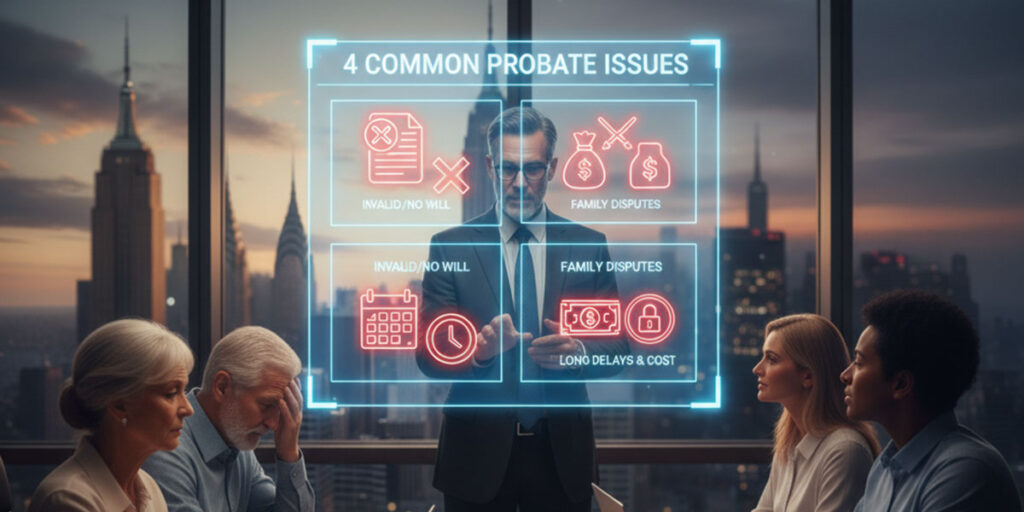
We consistently observe specific pitfalls that can derail an estate. Whether you are currently serving as an Executor or proactively planning your own legacy, understanding these common New York probate issues is crucial. This comprehensive guide will illuminate the four most frequent challenges encountered in New York probate and, more importantly, reveal the proven strategies we employ to overcome them, ensuring your family’s future remains secure.
The Perils of a Flawed Last Will and Testament
The Last Will and Testament serves as the cornerstone of any probate proceeding. Yet, errors frequently plague this vital document, rendering it vulnerable to challenges. New York’s Estates, Powers and Trusts Law (EPTL) mandates exceptionally strict requirements for a Will’s proper execution, often surprising those who attempt a do-it-yourself approach.
Strict Execution: The “Ceremony” You Can’t Skip
In New York, signing a Will is not merely putting ink to paper. It involves a precise legal ‘ceremony of execution.’ You must explicitly declare the document as your Will in the presence of two independent witnesses. Crucially, if a beneficiary acts as a witness, they risk forfeiting their entire inheritance. The Surrogate’s Court routinely rejects Wills drafted from online templates because families were unaware of these stringent ceremonial rules.
The Staple Affidavit: A Tiny Detail, a Major Delay
Imagine finding your loved one’s original Will, only to un-staple it to make a copy, then re-staple it. This seemingly innocuous act can trigger a significant problem. The New York Surrogate’s Court views misaligned staple holes with suspicion, often presuming someone tampered with the document, or someone removed or swapped pages. The court will then demand a ‘Staple Affidavit,’ requiring you to locate and compel the original attorney or those who handled the document to swear under oath that no alterations occurred. This simple oversight can delay the issuance of Letters Testamentary for months, prolonging an already stressful time.
When the Original Will Disappears
The court insists on the original Will. A photocopy is generally insufficient. If the original Will was last known to be in the deceased’s possession and cannot be found, New York law presumes they intentionally destroyed it. Overcoming this ‘Presumption of Revocation’ demands aggressive and costly legal hearings, often transforming a straightforward probate into a contentious battle for validation. Securing the original Will in a safe, accessible place is paramount.
Identifying and Notifying Legal Heirs: The Transparency Mandate
Even with a flawlessly executed Will, the Executor cannot proceed with the probate process in secrecy. New York law requires transparency, compelling the Executor to notify specific individuals that the probate proceeding is underway. This requirement ensures that all interested parties have an opportunity to review the Will and, if necessary, raise objections.
Who Are the “Distributees”?
Distributees are the legal next of kin—those individuals who would inherit the estate if no Will existed (intestacy). It is vital to understand that you must notify these individuals even if the Will explicitly disinherits them. They possess a legal right to examine the document and potentially challenge its validity. Failing to identify and properly notify all distributees can halt the probate process indefinitely.
The Challenge of the Missing Heir
Consider a common scenario: a New York City resident leaves their entire estate to their daughter. However, she has an estranged brother who moved abroad decades ago, whose current whereabouts, or even existence, are unknown. The Surrogate’s Court will not permit the Executor to advance the probate without his proper notification. Simply stating “I don’t know where he is” is unacceptable. The court demands rigorous proof of “due diligence” in attempting to locate every potential heir.
Our Proactive Approach to Kinship Challenges
At Morgan Legal Group, we take immediate action to resolve kinship crises. We collaborate with professional genealogists and private investigators, leveraging international databases, census records, and birth registries to trace missing heirs. If, after exhaustive efforts, an heir truly cannot be found, we meticulously compile an affidavit detailing our due diligence. We then petition the court to allow notification by “Publication” in a local newspaper, a crucial step that legally satisfies the notification requirement and allows the estate administration to progress.
Will Contests: Protecting Your Family’s Legacy from Litigation
Few issues are as emotionally and financially devastating as a Will Contest. This formal objection to the validity of a Last Will and Testament often ignites dormant family conflicts,